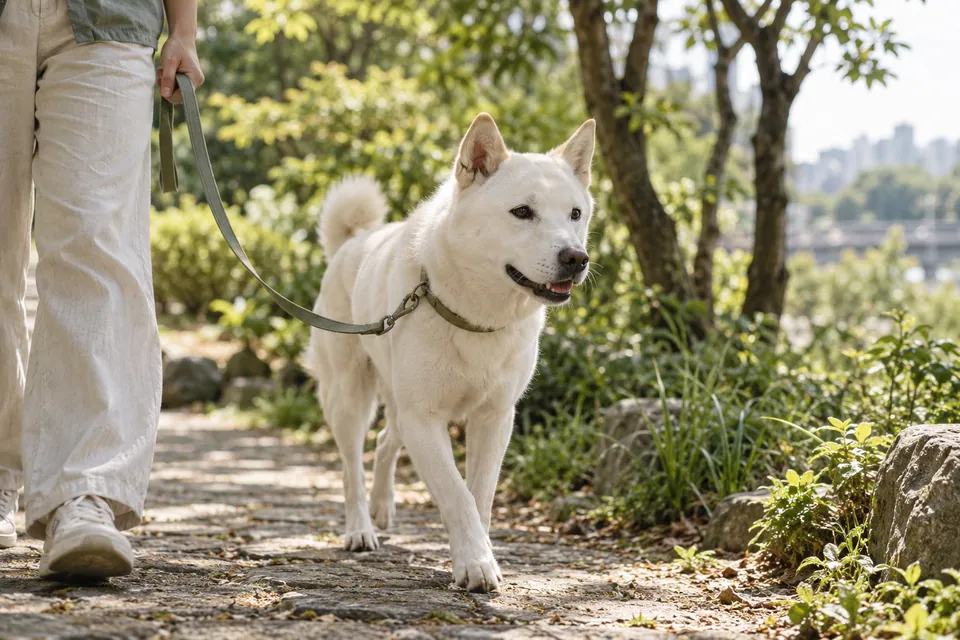
What should you do, and what can you skip, in the first 7 days?
The core of the first week is not to get a lot of tasks done, but to create an environment where the newly arrived animal feels safe and a day it can predict. Whether it is a dog or a cat, a baby or an adult dog or cat, it is natural to feel tense in an unfamiliar home.
The adoption guidance of the U.S. ASPCA (American Society for the Prevention of Cruelty to Animals) commonly describes this period with the 3-3-3 guideline. According to it, the first 3 days are a period when new sounds, smells and people can make the animal tense and overwhelmed, the following 3 weeks are a period for building basic training and a consistent routine, and the first 3 months are a period for getting to know each other's preferences and fears. It is safer to read these numbers not as a schedule that fits every animal, but as a guideline showing a rough flow.
So there are four main priorities in the first week. First, decide on a quiet spot where the pet can rest. Second, carry on the food and daily habits from the previous guardian or organization. Third, write the health checkup appointment and, for a dog, the pet registration (동물등록) schedule on a calendar. Fourth, divide up the roles the family will take on.
On the other hand, there are things you do not need to rush in the first week: giving lots of new toys and treats all at once, inviting relatives and neighbors over to say hello, holding the pet continuously to take photos, and going on long trips to unfamiliar places. These can be put off until the animal has settled, without being too late. The day-by-day flow is summarized in the table in the section below.
Why should you start slowly?
For an animal, a new home is a place where all the smells, sounds, people and daily rhythm it knew have disappeared. It does not yet know where it can hide, where the food and water are, or what kind of people live in this house. So for a few days it may hide, not eat well, sleep more than usual, or, on the contrary, appear excited.
The ASPCA states that for the first 3 days after adoption, a new pet may be tense and overwhelmed, so give it time to observe, keep up the routine, and do not force interaction with people or other animals. The same guidance also recommends creating a quiet, safe spot where the animal can relax.
International Cat Care points in a similar direction. It explains that even if there is no resident cat, a new cat can settle into one room first, and that introductions can begin after a few days to 1–2 weeks of settling, with the period differing from cat to cat. The gist of this guidance is that patience matters more than hurrying.
There are two things for the guardian to remember here. One is not to immediately conclude that behavior seen in an unfamiliar environment is the animal's personality or a behavior problem. What you see now may be an animal in the middle of adjusting. The other, conversely, is not to brush off changes that last a long time. If a worrying change such as not eating or drinking continues, you should consult a veterinarian. The criteria for that are summarized again in the last section.
What steps should you take care of in Korea after bringing a pet home? Dog registration duty and deadline
If you have brought a dog home in Korea, the legal procedure to take care of along with a health checkup is pet registration (동물등록). According to the National Institute of Animal Science (NIAS) guidance on the companion animal registration system, those subject to registration are owners of animals subject to registration under the Animal Protection Act (동물보호법), and those currently subject to registration are dogs aged 2 months or older. The Animal Protection Management System (국가동물보호정보시스템) also states that the system covers dogs aged 2 months or older that are kept in a house or quasi-residential building, or kept elsewhere for companionship purposes.
On the registration deadline, NIAS states that an application must be filed within 30 days of the date the owner acquires ownership of the animal, or the date the animal they own becomes an animal subject to registration. The same material states that an owner who does not register is fined up to KRW 1,000,000. However, because the amount of the fine may change when the law is amended, check the actual standard imposed in the text of the Animal Protection Act or with your city, county or district office.
The registration method is described as using either an internal or an external radio-frequency identification device. The Animal Protection Management System states that you must visit with your dog for the first registration, and that depending on the region you can register only through a designated agent (an animal hospital), so check in advance. So when you book the first veterinary appointment, if you also ask the hospital whether it handles pet registration, you can settle it in one go.
There are also things to report after registering. The Animal Protection Management System states that you should file a change report within 10 days when a registered animal is lost, and within 30 days when the owner or the owner's information changes, when the registered animal dies, or when a lost animal is recovered. It says reports can be made at a city, county or district office, Government24, or the Animal Protection Management System. If you adopted a dog that was already registered by the previous guardian, check whether you need to file an owner change report as the new owner.
There is one more thing to note. The content above is guidance for dogs. On the relevant guidance page of the Animal Protection Management System, no content on cat registration could be found, and NIAS also states that those currently subject to registration are dogs. Because no material that presents cats as a mandatory category could be found, this article does not assert a registration duty for cats. For timing and method, ask your city, county or district office.
How do overseas guidance and the Korean system differ?
The overseas sources this article referred to are the ASPCA, International Cat Care and the U.S. Centers for Disease Control and Prevention (CDC). They give general guidance on how to spend the first period after adoption, and they are not materials explaining legal provisions that set a registration duty and deadline as Korea does. So it is better to read the parts that say the same thing and the parts that differ separately.
The part that says the same thing is the way of settling in. The ASPCA says to provide a quiet spot and not to force interaction, and International Cat Care says to let a new cat settle in a separate room first. A guardian in Korea can apply the same approach.
On veterinary care, the ASPCA advises finding a nearby veterinarian and booking an appointment after adoption, and the CDC advises keeping up regular veterinary visits, vaccinations, deworming, and flea and tick control. Specific vaccination schedules and types of medication differ by country and region and by the animal's age and living environment, so in Korea it is right to decide them with the veterinarian in charge.
The part that differs is the system. The overseas materials do not mention Korea's registration within 30 days, change report deadlines, or designated agent system. The press release on the 3rd Comprehensive Plan for Animal Welfare (2025–2029) from the Ministry of Agriculture, Food and Rural Affairs (MAFRA) contains plans to expand the registration target to all dogs, to phase out the exemption provision for eup and myeon areas and island regions that have no registration agent, and to create conditions for a registration method that uses biometric information such as nose prints. Because this is a plan, the system currently in force must be checked through the guidance of the Animal Protection Act and the Animal Protection Management System seen above.
In summary, for how to spend the first week you can refer to overseas guidance, but for registration and reporting you must always use the current guidance of Korean institutions as the standard.
What should guardians check, day by day?
The table below summarizes the flow from before bringing the pet home to the end of the first week. It is an example of a general order, not a fixed rule, so if the animal cannot relax for a long time, slow down the steps. If you adopted an adult dog or cat, or an animal from a previous guardian, ask about its previous habits and adjust the table to fit.
Before bringing the pet home, the most important thing is to prepare the space and gather information. Decide on a resting spot, food and water, and a toilet area, and remove dangerous items (electric cords, small things that could be swallowed, open windows, detergents and medicines). Decide the family roles at this time too.
Keeping the food the pet was eating before is the simple way to reduce change. The sources opened for this article had no guidance on feeding amounts or how to switch food, so ask a veterinarian about the specific timing and method of any change.
If you have an existing animal, do not introduce them on the first day; start with them kept in separate rooms. International Cat Care advises not placing items used by the existing cat in the room used by the new cat, and using the new cat's own items or new items. It says to divide the introduction into five steps of scent exchange, taking turns exploring each other's spaces, viewing through a barrier, contact watched by the guardian, and short unsupervised time, and to move on only when the previous step is going smoothly.
| Time | What to do | What you do not need to do |
|---|---|---|
| Before bringing it home | Decide the resting spot, food and water, and toilet area, remove dangerous items, get the food it was eating, its daily habits and veterinary records from the previous guardian, decide family roles | Buying lots of toys and supplies all at once |
| Day 1 (arrival day) | Put it in a quiet spot first, give the food it was eating and water, show it the toilet spot, open only part of the home | Inviting guests, forcing holding or play, introduction to existing animals |
| Days 2–3 | Feed at the same times, respect its hiding spots, record how much it eats and its urine and stool, book the first veterinary visit | Bathing, going out to unfamiliar places, switching to new food |
| Days 4–5 | Watch whether its behavior is loosening up and widen the space it can access little by little, start scent exchange with existing animals | Rushing face-to-face meetings |
| Days 6–7 | Have the first veterinary visit (if possible), for a dog check the registration schedule and ask about hospitals that act as agents, gather what the family noticed in the first week | Changing rules all at once or setting many training goals |
What are common misunderstandings in the first week?
The first misunderstanding is the idea that to show a welcoming heart you must hold the pet often and play a lot. However, the ASPCA advises not forcing interaction with people or other animals for the first 3 days. Quietly staying in the same room until the pet approaches on its own can be a way of welcoming it.
The second misunderstanding is the interpretation that if it hides or does not eat well for the first few days, it dislikes our home. This may be an adjustment reaction in an unfamiliar environment, and it is not the guardian's fault or a sign that the pet has a bad personality. However, if the not-eating state lasts long, it may be a health problem rather than an adjustment problem, so tell a veterinarian.
The third misunderstanding is the idea that switching right away to better food helps it settle in better. If even the food it was eating changes in an unfamiliar place, the pet goes through the changes all at once. If you can get the previous food, simply continuing it first is the simpler way. This article does not recommend a specific food, and if you need to switch, consult a veterinarian.
The fourth misunderstanding is the idea that if you make it meet the existing animal quickly, they will become friends quickly. International Cat Care advises not rushing the introduction and moving to the next step only when each step is going smoothly, and says that if signs of tension such as hissing or growling appear, you should distract them, separate them, and try again later. It does not recommend scolding the animal at this time.
The fifth misunderstanding is the idea that dog registration can be sorted out later. NIAS states that you must apply within 30 days of the date you acquire ownership. If you look into it when booking the first visit, the schedule will not slip.
When to consult a veterinarian
It is better to have the first health checkup even if the pet does not look sick. The ASPCA advises finding a nearby veterinarian and booking an appointment right after adoption, and the CDC also advises keeping up regular veterinary visits, vaccinations, deworming, and flea and tick control. If you bring the veterinary records, vaccination history and information on the food it was eating from the previous guardian or organization, it is easier for the veterinarian to carry on from there. This article does not decide diagnosis or treatment, vaccination timing or medication doses.
In the following situations, do not wait for the date of the first visit; contact the clinic. Contact it when it keeps not eating or drinking, when vomiting or diarrhea is repeated, when it is limp and unwilling to move, when it looks like it is having difficulty breathing, when it cannot urinate or defecate, or when it shows a noticeable wound or pain. For urgent symptoms, it is better to call the clinic, tell them the condition and get guidance. Because this article only summarizes general guidance from institutions, leave the judgment of the individual condition to a veterinarian.
Behavior problems are also a matter for consultation. If the introduction to an existing animal keeps going wrong, if an animal has been hiding and not coming out for several days, or if it scratches at the door in distress in a confined space, then as International Cat Care advises, you can discuss it with your veterinary team and, if needed, be referred to a behavior specialist.
Take care of people's health as well. The CDC advises washing hands after touching animals or handling supplies and waste, not bringing pets and their supplies into the kitchen, and says that children under 5, people 65 or older, people with weak immune systems and pregnant people have a higher risk of some diseases spread by cats and rodents. If someone in the family is like this, consult a veterinarian and a doctor at the first visit.
Frequently asked questions
Q What should I do first on the first day?
The top priority is to decide on a resting spot, food and water, and a toilet area, and to start in a quiet place. The ASPCA advises not forcing interaction for the first 3 days, keeping up the routine, and creating a safe spot. Avoid calling in unfamiliar people or holding the pet for a long time.
Q How long should I keep giving the food it was eating?
Simply continuing what it was eating before is the simpler way. The official sources opened for this article had no specific timing or method for switching food, so consult a veterinarian if you want to switch. Be sure to ask the previous guardian about the type of food and feeding times.
Q By when must I register a dog?
NIAS states that you must apply for registration within 30 days of the date you acquire ownership, or the date the animal you own becomes subject to registration. The target is dogs aged 2 months or older. Depending on the region you can register only through a designated agent (an animal hospital), so check in advance.
Q Do cats also have to be registered?
The guidance of the Animal Protection Management System and NIAS checked for this article presents dogs as those subject to registration, and no content setting a registration duty for cats could be found. Check the scope currently in force again with your city, county or district office or the Animal Protection Management System.
Q When should I introduce it to an existing animal?
Do not let them meet on the first day; start with them in separate rooms. International Cat Care advises dividing the steps into scent exchange, viewing through a barrier and watched contact after the new cat has settled first, and moving on only when the previous step is going smoothly. The period differs from animal to animal and can take from a few days to 1–2 weeks or more.
Q When is a good time to go for the first veterinary visit?
It is good to book it right after adoption. The ASPCA advises not forgetting to book a veterinary appointment after adoption. Travel can be a big stress, so watch its condition and discuss the date with your veterinarian, and if there are worrying symptoms, contact the clinic without waiting for the schedule.
Limits and scope of this guide
This is an explanation for general pet owners and does not decide diagnosis, prescription, vaccination schedules or feeding amounts. For dog registration, only the guidance on dogs was checked, and the cat duty, the actual standard for imposing fines, and the designated agents by region could not be confirmed. Laws may be amended, so check again with the Animal Protection Management System and your city, county or district office. The guidance on keeping up the food is not content confirmed directly in an official source.
Translated from the Korean edition · Editorial draft, not professionally reviewed. The Korean edition is an explainer newly written from public sources; it is not a full translation of those sources. Veterinary expert review has not been completed. For decisions about your pet's health, talk to a veterinarian who knows your pet.
Sources and check dates
- Guide to the pet registration system (동물등록제도 안내) ↗
Used as the basis for the registration target for dogs (aged 2 months or older), the registration method, and the change report deadlines (10 days for loss, 30 days otherwise).
- Companion animal registration system (반려동물등록제) ↗
Used as the basis for the registration duty under the Animal Protection Act (동물보호법), the registration deadline within 30 days of the date ownership is acquired, and the fine guidance.
- Press release on the 3rd Comprehensive Plan for Animal Welfare (2025–2029) (제3차 동물복지 종합계획(2025~2029) 보도자료) ↗
Used as the basis for explaining that the policy plan to expand the registration target to all dogs differs from the system currently in force.
- Adoption Tips ↗
Used as the basis for the 3-3-3 guideline, providing a quiet spot, not forcing interaction, separating the existing animal's toys, and booking a veterinary appointment after adoption.
- Introducing cats ↗
Used as the basis for a separate room for the new cat, the five-step introduction, and the guidance on signs of tension and consulting the veterinary team.
- About Healthy Pets ↗
Used as the basis for regular veterinary visits, handwashing, handling of supplies and waste, and guidance for higher-risk groups.
Korean edition checked · translated · each source may have a different check date. No paid partnerships.
This guide relies on 1 Korean law or notice. Current effective dates and upcoming amendments are listed on Korean law check status. This is not legal advice.