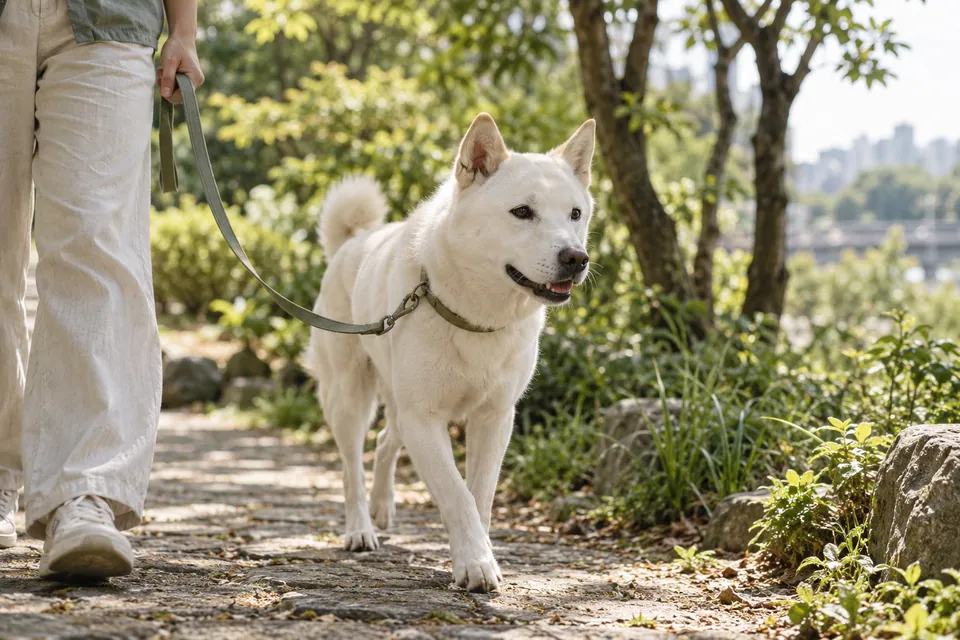
How do you teach a dog that pulls on the leash?
To put it briefly, the basic method is to not move forward at the moment the dog pulls on the leash, to move forward only when the leash is slack, and to reward with treats or praise when the dog walks beside the owner. San Diego Humane Society explains the core of this method in one sentence: "don't move in the direction the puppy is pulling." The guidance is to stop when the leash goes tight, wait until it goes slack, and then continue walking. RSPCA Australia also recommends reward-based loose leash walking, and advises that when the dog pulls, you stop and show it that pulling does not get it where it wants to go.
The principle can be put in one line. As the experience of reaching a desired place by pulling on the leash builds up, the pulling behavior actually gets stronger, and as the experience of walking continuing when the leash is slack builds up, loose walking increases. San Diego Humane Society explains that puppies spend energy only when they have a reason, and that by pulling they get real rewards such as sniffing bushes and meeting people and other dogs. This article interprets that regardless of the owner's intent, each time the dog drags the owner along, it learns that pulling works.
Another important point is that this is not a skill acquired overnight. VCA, a US animal hospital chain, advises that most dogs need months of practice to learn loose leash walking. So rather than judging after a few days that it is not working, repeating short practice sessions regularly is realistic. This article covers, in order, the reasons for pulling, how to practice, what not to do, how to tell it apart from reactivity, and the South Korean rules and the criteria for consulting a professional.
Why do dogs pull on the leash?
Leash pulling often arises not because the dog has a bad personality or ignores the owner, but because walking in step with a leash is not a natural thing for a dog. VCA advises that dogs pull to get where they want to go, and that walking on a leash is not a skill that comes automatically to a dog. It also explains that many dogs lean into the pressure of the collar instead of backing off. RSPCA Australia advises that teaching leash walking is difficult because dogs want to explore the world at a much faster pace than people.
The table below arranges the reasons so owners can look at them. The first three items are what the organizations above explained directly, and excitement and anxiety are this article's interpretation, expanded from those explanations so that owners can observe them.
Also, pulling does not always come from the same reason. Some dogs pull because they want to sniff, some because they want to meet other dogs or people, and some because they cannot calm their excitement. Conversely, there can also be dogs that go forward to get away quickly because they are scared, so it is good to look not only at the pulling but also at what was there just before the dog pulled. If a dog always pulls at the same point on the same route, that is a clue that something there draws the dog.
| Reason | What you may observe | Basis and interpretation |
|---|---|---|
| To get where it wants to go | Rushes forward when the destination comes into view | VCA: dogs pull to get where they want to go |
| A faster pace than people | Always ahead of the owner's steps | RSPCA Australia: dogs want to explore much faster than people |
| Smells, food, meetings | Pulls hard in front of grass, the ground, or other dogs | San Diego Humane Society: sniffing bushes, food on the ground, and greetings become rewards |
| Excitement | Bolts out as soon as the walk starts | This article's interpretation: leaving before the excitement at the door has settled can make pulling stronger |
| Anxiety, fear | Tries to get away quickly from unfamiliar sounds or objects | This article's interpretation: securing distance may need to come before reward training |
What methods are used, and how do you practice?
There is no single method; several are combined. The common backbone the organizations advise is that it is reward-based and that the dog does not get to move forward when it pulls. San Diego Humane Society advises first doing an attention exercise that rewards looking at the owner, then practicing, with a treat placed out of reach of the leash, moving forward only when the leash is slack. It explains that afterward, on real walks too, you reward the dog for checking in with the owner, and when it pulls you stop, wait for the pressure to release, and then continue walking. VCA advises starting indoors or in a quiet yard, rewarding with treats and praise, and attaching a cue word such as "let's go."
The table below arranges these pieces of guidance in order. Individual dogs may need adjustment with a trainer.
This article's suggestion is that it is better to keep practice short. San Francisco SPCA advises, to the effect that if you give dinner after returning home from the walk, the dog is a little hungry during the walk and responds better to treats. Rather than doing one long session, it is better to practice often in easy-to-succeed settings, such as a few minutes at the door and a few minutes on a short path in front of the house.
| Method | How to do it | Basis or interpretation |
|---|---|---|
| Practice first indoors or in the yard | Walk with a slack leash in a place with few distractions, reward with treats, attach a cue word | VCA: start indoors or in a quiet yard |
| Reward looking at the owner | Give a treat right away when the dog makes eye contact or looks back | San Diego Humane Society: attention exercise |
| Stopping | Stop when the leash goes tight and wait until it goes slack | San Diego Humane Society, VCA, RSPCA Australia |
| Reward when beside you | Give a treat at the owner's side every few steps | RSPCA Australia: reward often while the dog is in the correct position |
Is it all right to jerk the leash or use tools that cause pain?
The materials opened do not recommend hard leash-jerking corrections or tools that cause pain. VCA explains that training collars such as slip, choke, prong, and electric shock all rely on pain to stop pulling, and advises that pain-free training is the priority when building a trusting and healthy relationship. RSPCA Australia says that choke chains, slip collars, and spiked prong collars must not be used, explaining that such tools cause animals pain and distress and can injure the neck. San Diego Humane Society advises that aversive-based methods can damage the relationship between owner and dog and are known to increase fear and aggression. San Francisco SPCA explains that associations with pain can cause or worsen aggression, and that even if pain stops barking for a moment, it does not reduce the underlying frustration.
There is also evidence on strain to the neck and body. VCA advises that when strong pressure is put on a collar the dog can be hurt, especially with training collars, and explains that some training collars have no limit on how far they tighten, so there is a risk of choking if the leash gets caught. It also advises that a regular collar is not suitable for a dog that pulls until it coughs or its breathing sounds rough. RSPCA Australia warns that the shock of hitting the end of the leash and being jerked can injure the neck, and explains that a harness is ideal in that it protects the neck.
The comparison of harnesses and collars is covered in a separate article, so only two points are noted here. VCA cautions that some anti-pull harnesses can injure the shoulders, and RSPCA Australia advises that if leash walking is not going well, using a harness that clips at the front requires help from a reward-based trainer. This article does not recommend any specific product, and the important point is that for any equipment, a tool does not replace training. Even if you change equipment, if the experience of moving forward when pulling continues, the pulling can continue. As for retractable leashes, RSPCA Australia does not recommend them because control is reduced and they encourage pulling, and VCA advises avoiding them because they can cause severe friction burns to both people and animals.
How is pulling different from reactivity (barking and lunging at other dogs)?
Pulling on the leash and barking and lunging at other dogs or people overlap in places but may not be the same problem. Pulling is mainly behavior to get quickly where the dog wants to go, while reactivity refers to cases where a dog shows a strong reaction, such as barking or charging to the end of the leash, when a specific target appears. VCA advises that if a dog charges to the end of the leash or barks, or frantically chases or tries to approach animals, people, cars, or bicycles, you should ask the veterinarian for a referral to a behavior consultant and trainer.
San Francisco SPCA explains that reactions on leash often come from frustration at wanting to meet and greet a dog while the leash blocks it. That material advises that if the owner is tense the leash goes tight and the dog may pull and bark more, so you should stay calm and approach in a bright voice. It also introduces stepping out of the way to keep distance when another dog passes, and scattering treats on the ground to redirect the dog's attention. However, not every reaction comes only from frustration. If the behavior is out of fear, the approach can differ, so this article does not conclude the cause.
So the owner's first step is to observe which of the two it is. The list below is this article's checklist for owners and is not a diagnosis.
- Does the dog only pull, and quickly return to normal once the target has passed
- Do barking or lunging appear only when it sees a specific target
- Does the reaction lessen when the distance is increased
- Does it change when the leash is let go, or is it the same regardless of the leash
If the dog reacts strongly only when it sees a target, or it is the same with or without a leash, it is advisable not to try to solve it with simple pulling training alone and to consult a veterinarian.
What must you follow regarding walking leashes in Korea?
The full content of South Korean walking rules is covered in the walking article, so here only the points directly related to training are noted. The companion animal guidance of Geumcheon-gu Office in Seoul advises wearing a leash or chest leash within 2 meters in length when going out, and explains that even if the leash itself is longer, holding it short so that it is actually within 2 meters is regarded as meeting the standard. Seoul Metropolitan Government guidance also explains keeping the length of the leash and chest leash within 2 meters. This 2 meters is the upper limit for leash length when going out; conversely, the Easy-to-Find Practical Law Information of the Ministry of Government Legislation advises that there is a separate keeping and management standard that, when a dog is kept tied by a leash at home, the leash should be 2 meters or longer (Animal Protection Act (동물보호법) Enforcement Rule, Appendix 2). Applying the going-out standard to training, this article sees it as right to do pulling practice too while holding the leash short, within 2 meters.
Overseas training materials and South Korean rules do not conflict. RSPCA Australia recommends a leash of about 2 meters and advises that if the leash is too short it can actually encourage pulling, and the length of about 2 meters is on the same line as the South Korean standard. However, a long leash makes it hard to keep it slack, so it is good for the owner to practice holding the leash gathered short.
In addition, the Geumcheon-gu Office guidance explains wearing an ID tag and picking up excrement immediately as matters to follow when going out in Korea. So even while standing still for training, you must bring poop bags and an ID tag. This article does not cover fine amounts, regulations on dangerous dog breeds, or rules for shared areas of buildings; please check the latest guidance from the local government or the relevant ministry.
What are common misconceptions, and when should you consult a professional?
Comparing owners' common misconceptions with the materials opened gives the following.
- You have to teach by pulling the leash hard: RSPCA Australia warns that the shock of being jerked at the end of the leash can injure the neck, and San Diego Humane Society advises that aversive-based methods are known to increase fear and aggression.
- Just changing equipment solves it: San Diego Humane Society explains that suitable equipment can greatly reduce pulling, but that the rest must still be taught.
- Letting the dog walk ahead is good because it is happy: walking ahead is not itself the problem; the problem is that the experience of being pulled along with a tight leash reinforces pulling.
- Teaching once or twice is enough: VCA advises that most dogs need months of practice.
The criteria for considering a consultation with a veterinarian or veterinary behavior specialist are as follows. This is not a diagnosis but this article's summary.
- The dog charges to the end of the leash or barks and lunges, and it is hard for the owner to control (VCA also recommends a behavior specialist and trainer in such cases)
- There is almost no change even after practicing regularly for months
- Physical symptoms such as coughing, rough breathing sounds, or pain around the neck appear together with pulling
- The dog is afraid of the walk itself or its behavior has suddenly changed, or it shows signs of trying to bite people or dogs
This article's view is that if behavior has suddenly changed, it is safer to first have an animal hospital check for a health problem. San Francisco SPCA advises finding a qualified person such as a veterinary behaviorist, a certified applied animal behaviorist, or a certified professional trainer if you need help, but qualification systems and organizations in Korea must be checked separately.
Frequently asked questions
Q What should I do first when my dog pulls on the leash?
At the moment the leash goes tight, stop walking, wait until it goes slack, and then continue walking. This is the basic principle San Diego Humane Society and RSPCA Australia advise, and it should be accompanied by rewarding with treats or praise when the dog walks loosely.
Q My dog pulls because the walk is so exciting. What should I do?
VCA advises starting in a place with few distractions, such as indoors or in a yard, and explains that when the dog steps back from or moves away from something that draws its attention and a sign of the leash going slack appears, you should reward right away. Setting off after the dog has calmed down at the door is this article's suggestion; if it is hard to manage, consult a trainer.
Q Does the pulling go away if I use a harness?
It is hard to say equipment alone solves it. RSPCA Australia says a harness protects the neck but recommends help from a reward-based trainer, and VCA cautions that some anti-pull harnesses can injure the shoulders. Product comparisons are covered in another article.
Q Can I practice with an automatically extending leash?
VCA does not recommend extending leashes because they can cause severe friction burns, and RSPCA Australia also advises that they reduce control and encourage pulling. South Korean guidance says to keep the leash within 2 meters, so practicing with a fixed-length leash is better.
Q My dog barks and lunges when it meets other dogs. Will pulling training solve it?
Pulling and reactivity may not be the same. VCA advises that if a dog charges to the end of the leash or barks, you should ask the veterinarian for a referral to a behavior consultant and trainer, and San Francisco SPCA introduces keeping distance and redirecting attention with treats. It is advisable to consult a veterinarian first.
Q How much practice does it take before leash pulling decreases?
VCA advises that most dogs need months of practice. Repeat short practice sessions regularly, and rather than giving up because there is no change soon, try changing the environment and the rewards, and consult a trainer if needed.
Q Do I need to stop my dog from sniffing on walks so that it doesn't pull?
The materials opened have no evidence that preventing sniffing is the solution. San Diego Humane Society explains sniffing bushes as one of the rewards a dog gets by pulling, and the solution it presents is not moving in the direction the dog is pulling. VCA advises that dogs need time to sniff, explore, and engage with their environment.
Limits and scope of this guide
This article is general information summarizing the shelter, animal hospital, and local government guidance that was opened, and is not a diagnosis or training prescription for a specific dog. If reactivity is suspected or there are physical symptoms, consultation with a veterinarian and a behavior specialist is needed; comparisons of equipment such as harnesses, walking amounts, the specifics of managing sniffing time, regulations on dangerous dog breeds, and fines were not covered.
Translated from the Korean edition · Editorial draft, not professionally reviewed. The Korean edition is an explainer newly written from public sources; it is not a full translation of those sources. Veterinary expert review has not been completed. For decisions about your pet's health, talk to a veterinarian who knows your pet.
Sources and check dates
- Loose Leash Walking With Dogs (줄 당김 조절) ↗
Used as the basis for the reasons dogs pull, stopping, rewarding, and starting indoors, pain-based training collars and strain on the neck, and the criteria for consulting a behavior specialist.
- What equipment should I use when teaching my dog or puppy to walk on a leash? ↗
Used as the basis for dogs wanting to explore faster than people, the principle of stopping and rewarding, the non-recommendation of choke, prong, and extending leashes, and the leash length of about 2 meters.
- Training Tips: Loose Leash Walking ↗
Used as the basis for the principle of not moving in the direction the dog pulls, the attention exercise, and the non-recommendation of aversive-based methods.
- Dog-Dog Aggression On Leash (Reactivity) ↗
Used as the basis for the explanation that on-leash reactivity can come from frustration, keeping distance and scattering treats, the warning about pain-based tools, and how to find a professional.
- What to follow when going out with a companion animal (leash within 2 m, ID tag, picking up excrement) (반려동물 외출 시 지켜야 할 사항(목줄 2m 이내, 인식표, 배설물 수거)) ↗
Used as the basis for the leash or chest leash within 2 meters when going out, the guidance that holding the leash short counts as compliance, and the ID tag and picking up excrement.
- Caring for dogs and cats (living with companion animals) (반려견·반려묘 돌보기(반려동물과 생활하기)) ↗
Used as the basis for the explanation that a leash length of 2 meters or more when keeping a dog tied (except where unavoidable, Animal Protection Act (동물보호법) Enforcement Rule, Appendix 2) is a different situation from the going-out standard of 2 meters or less.
- Seoul in My Hand: guide to walking dogs (2023.05.19.) (내 손안에 서울 반려견 산책 안내(2023.05.19.)) ↗
Used as the basis for the guidance on keeping the length of the leash (chest leash) within 2 meters.
Korean edition checked · translated · each source may have a different check date. No paid partnerships.
This guide relies on 1 Korean law or notice. Current effective dates and upcoming amendments are listed on Korean law check status. This is not legal advice.