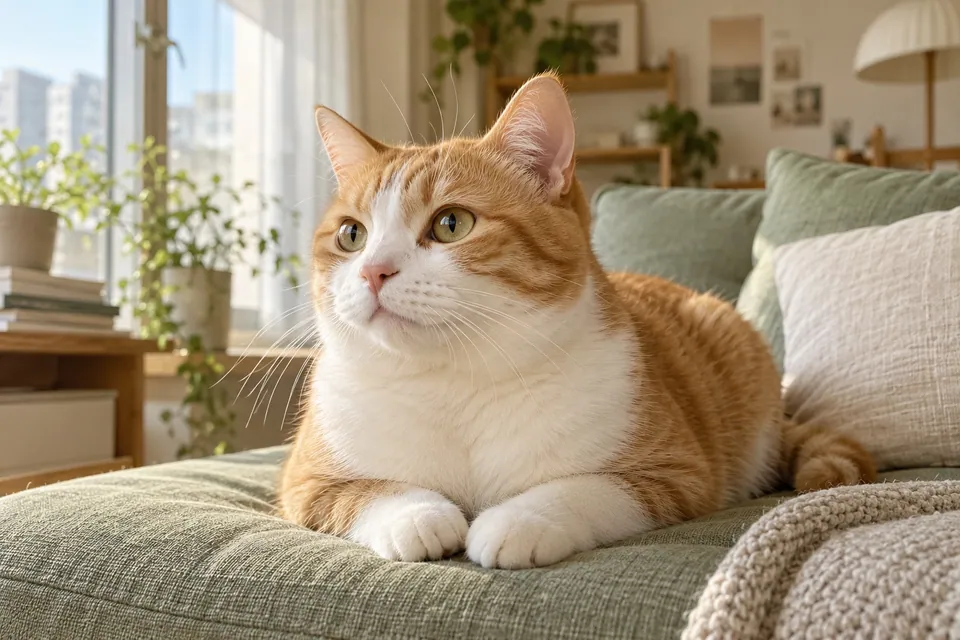
Is it strange behavior for a cat to eat grass?
To start with the conclusion, a cat nibbling grass or potted plants is hard to regard on its own as abnormal behavior or a sign of illness. In an owner survey by researchers at the University of California, Davis School of Veterinary Medicine, plant eating was commonly reported even in cats that looked healthy (Animals 2021, journal paper).
However, "common" and "safe" are different things. The grass-eating behavior itself may be nothing to worry about, but the risk differs greatly depending on which plant the cat eats. Young grass grown for people to feed, such as oat or barley sprouts, and a lily bouquet brought in from a florist may both look like "grass eating," but they are entirely different problems. This article sets out in turn how far the research on why cats eat grass has confirmed, how to understand cat grass, and which plants must be avoided.
Owners have three worries most often. First, whether it is all right to leave a cat that nibbles potted grass. Second, whether it is all right when a cat vomits after eating cat grass. Third, whether the cat seeks out grass because it is short of nutrition. This article takes up these three questions in order.
This article organizes general information, and if your cat is sick right now or may have eaten a toxic plant, contacting a veterinary clinic first comes before reading this article. If it is not urgent, please use the content below as criteria for checking.
Why do cats eat grass? What research has confirmed and hypotheses
There are several widely known explanations for why cats eat grass. They eat it to vomit because they feel sick, they eat it to bring up hairballs, they eat it because they lack nutrition, they eat it to expel intestinal parasites, or it is a habit inherited from wild ancestors. Which of these is the accepted view has not yet been settled, and it is important to separate what research has confirmed from what is hypothesis.
What has been confirmed is the owner survey result. The University of California, Davis paper (Animals 2021) states that it received owner responses of 1,000 to 2,000 each in two surveys carried out over 10 years. According to the body of the paper, cats that looked sick before eating plants were only 6 percent of the total in the first survey and 9 percent in the second. That is, most cats were going about their day as usual and then ate grass, and the explanation that cats eat grass because they are sick was not supported by this survey.
The share of owners who answered that their cat often vomits after eating plants was 27 percent to 37 percent across the two surveys (paper abstract). Looked at the other way, it means that well over half of cats did not often vomit even when they ate grass. The researchers interpreted that in some cats, gastrointestinal discomfort may be related to vomiting.
As another survey result, the paper records that in one survey, 71 percent of cats were observed eating plants at least 6 times, 61 percent more than 10 times, and 11 percent were never observed eating them. This means grass eating is something that several out of ten cats repeat, but not every cat does it.
There is a clue about the hairball hypothesis. In the same paper, short-haired and long-haired cats showed no clear difference in how often they ate plants, and the researchers regarded this as a result unfavorable to the hypothesis that cats eat grass to bring up hair. Care of hairballs themselves is covered in a separate article, "How much evidence is there for hairball food and hairball care?".
Differences by age were also reported. Younger cats ate plants more often than older cats, and were less likely to look sick before eating or to vomit after. Cats aged 1 year or older ate grass most often, whereas for cats under 1 year that ate plants, the share that mainly ate grass was 30.9 percent, lower than for those aged 1 year or older (52.5 percent or more), the paper's table shows.
The parasite-expulsion hypothesis is an interpretation the researchers offered in the discussion section. There is an observation that swallowing plants in wild carnivores is linked to control of intestinal parasites, and a proposal that fibrous plants may help expel parasites. However, the paper itself states to the effect that confirming this would need a separate experiment with cats whose parasite counts are known, so it should be read as a hypothesis. A commentary for veterinarians written by the same researcher (dvm360) also says the hypothesis of an inborn habit needs more study.
In summary, what the research showed fairly clearly is that "cats that look healthy also commonly eat grass," and why they eat it still cannot be stated definitively.
Is it true that cats eat grass because they lack nutrition?
"A cat seeks grass because it lacks nutrition" is the most common explanation among owners, but in the material confirmed this time, no evidence supporting it was found. The Davis researchers' survey paper, which was opened and read directly for this article, dealt with feeling sick, inducing vomiting and expelling hairballs as the hypotheses examined in relation to plant eating, and did not present results demonstrating a nutritional deficiency. A commentary introducing the same researcher's earlier study of dogs (dvm360) also summarized that grass eating is common in normal dogs and appears largely unrelated to disease. The dog study results cannot be carried over to cats as they are, but it is useful to note that the researchers' line of thinking points in the same direction.
Cats are carnivores that get protein, fat and the vitamins and minerals they need from their prey, so the basis is weak for explaining that they eat grass to fill up on nutrients in grass. A cat's basic nutritional structure is covered in a separate article, "What does it mean that cats are carnivores when choosing food?".
That said, it also cannot be asserted that grass eating has nothing to do with nutrition. A survey depends on owners' observations and memory, and is not a study that directly measured nutritional status. So the safe wording is "evidence that it is caused by a nutritional deficiency was not confirmed," not "it has nothing to do with nutrition."
The practical criterion is this. If a cat that regularly eats commercial food and has stable weight and condition eats grass, there is little reason to suspect a nutritional deficiency first. Conversely, if the number of times it eats grass suddenly increases, or appetite drops and weight falls, or vomiting has become frequent as well, the grass may be a symptom, not the cause, so the order is to check health at a veterinary clinic first before changing the diet.
What is cat grass, and is it all right if a cat vomits after eating it?
Cat grass commonly refers to grass grown from the young sprouts of grains such as oats, wheat and barley and given to cats. Many people plant seeds and grow it at home or obtain it already grown in a pot, and even when the name is the same, you need to check the package and labeling for which plant it is. This article does not recommend choosing any product and covers only criteria for owners to check.
In the paper, the Davis researchers write that providing a grass garden for indoor cats seems reasonable. Many cats have an inborn tendency to eat plants, and cats that cannot go outside have no suitable plants to eat in the house. Providing safe grass separately may help reduce the chance that the cat nibbles toxic plants in the house. However, please distinguish that this is the researchers' practical suggestion, not medical evidence that cat grass is necessary for health.
Then is vomiting after eating all right? In the survey above, cats that often vomited after eating plants were 27 percent to 37 percent, so vomiting occasionally after eating grass is not an uncommon phenomenon. Grass blades may irritate the throat or stomach and cause vomiting, and hair or stomach contents swallowed along with the grass may come up too. If the cat is usually active, eats well right after vomiting, and vomits only once or twice now and then, it is often regarded as a temporary reaction to chewing a lot of grass. However, this is a general explanation, not a diagnosis.
An increase in the number of vomiting episodes, frequent vomiting unrelated to grass, or a drop in appetite and activity is another matter. In such cases, do not assume grass is the cause and the cause must be checked at a veterinary clinic. Specific criteria are set out in the last section.
As a way to control the amount of grass, rather than placing one pot that is too large, it is better to place a small pot and watch how much the cat nibbles and whether it vomits. Remove moldy soil, saucers with standing water, and sprouts that have been left for a long time and withered.
Which plants should I be especially careful about in Korea?
The plant that households keeping cats in Korea must know is the lily. Lily bouquets are common at florists and as gifts, and many homes keep them as decoration. A column written by a Korean veterinarian (Health Kyunghyang, March 2022) explains that lilies can be fatal to cats even in small amounts, and advises that not only the petals, leaves and stems but also the pollen can be poisonous. It also writes that there is no separate test to confirm lily ingestion, so the owner must explain to the veterinarian the possibility of ingestion and whether lily was seen in the vomit.
What about overseas material? The Merck Veterinary Manual explains that the so-called true lilies of the genus Lilium and the genus Hemerocallis cause kidney injury in cats and can lead to acute kidney failure if untreated. The same document says drooling, reduced appetite, lethargy and vomiting can appear between 1 hour and 3 hours after exposure, that between 12 hours and 30 hours vomiting worsens, urine output increases and dehydration sets in, and that if treatment is late, death can occur within 3 days to 7 days. If treatment is started early, the outlook is good, but treatment after urine output has decreased or stopped is said to have a poor outlook.
The plant guide of the American Society for the Prevention of Cruelty to Animals (ASPCA) lists the lily (Lilium) as a plant toxic to cats and gives kidney failure as the cat's sign. The Cornell Feline Health Center advises that some lilies are highly toxic and any part of the plant can be a problem, that if ingestion is suspected you should take the plant and go to a veterinarian immediately, and that you should not induce vomiting before a veterinarian or poison control service instructs you to.
Vase water and pollen are also dangerous. The US Food and Drug Administration (FDA) advises that the whole lily plant, including stems, leaves, flowers, pollen and even the water in the vase, is toxic to cats. It explains that a cat can be poisoned just by grooming and licking a few grains of pollen off its fur, and that drinking vase water can cause fatal kidney failure in less than 3 days. The FDA says to contact a veterinarian or a pet poison helpline immediately if ingestion is suspected, and warns that if treatment is delayed 18 hours or more after ingestion, it usually becomes irreversible kidney failure. So not bringing lily bouquets into a home with cats is the surest prevention.
There is one more point to note. Not everything with "lily" in its name carries the same risk. The Merck Veterinary Manual distinguishes that peace lily (spathiphyllum) and calla are not true lilies and so do not carry the same kidney injury risk, but explains that they can cause irritation inside the mouth because of insoluble oxalates. Lily of the valley is also not a true lily but is classified separately as a plant with toxic components that act on the heart, and the Cornell Feline Health Center and the FDA also name lily of the valley as a highly dangerous plant for cats, so it must not be treated as a safe substitute. Conversely, daylily is in the same risk group even though it has no lily in its name. If you are unsure about a flower's name, ask the florist for the scientific or English name, and if it is not certain, not bringing it into the home is the simplest method.
How does this differ from overseas guidance, and what other plants are risky?
Korean and overseas guidance do not differ in broad outline. The difference is that overseas material has better organized lists and places to get advice. The ASPCA runs a list in which you can look up plants toxic and non-toxic to cats and dogs by name, and states that this list does not include every plant. It also gives an animal poison control phone line to call when poisoning is suspected, but this is a US organization, so in Korea it is more realistic to contact a nearby veterinary clinic or a hospital that provides emergency care first. Hospitals that see patients at night in Korea differ by region, so it is good to save the contact details of two or three nearby hospitals in advance.
Besides lilies, a few of the common houseplants that the Merck Veterinary Manual introduces as possibly problematic for animals are relayed here. This is not a complete list, so check names yourself in the ASPCA list and similar sources.
- Dieffenbachia, pothos and philodendron: introduced as plants that cause pain and irritation in the mouth and throat when chewed, and it advises that drooling and pawing at the mouth can occur.
- Sago palm: vomiting, diarrhea and liver damage can occur, and the seeds are the most toxic but all parts are said to be toxic. The manual writes that dogs are especially sensitive.
- Azaleas and rhododendrons: every part including nectar, flowers, leaves and stems has toxic components, so gastrointestinal, cardiovascular and central nervous system abnormalities can occur, and it advises that even eating a few leaves may require watching for heart abnormalities for a day.
- Aloe: introduced as a plant that can cause gastrointestinal signs such as reduced appetite, vomiting and diarrhea.
- Poinsettia and ivy: introduced as mainly causing gastrointestinal signs such as reduced appetite, vomiting and diarrhea.
According to the explanation of the ASPCA plant list, plants marked as non-toxic or classified as causing only mild gastrointestinal signs are not expected to be life-threatening, but eating any plant can cause vomiting or stomach upset. So even "non-toxic plants" are not recommended to be eaten in large amounts.
One more thing: grass and bouquets that pesticides, fertilizers or herbicides have touched can be dangerous regardless of the plant's own toxicity. Bouquets and pots bought at a florist may have been treated with agents for pest control or preservation, and outdoor flower beds and lawns may also have been sprayed. The commentary written by the Davis researcher (dvm360) also advises keeping pets that eat grass away from chemically treated lawns and toxic plants.
| What to check | How to check | When in doubt |
|---|---|---|
| Plant name (including scientific name) | Check the pot label or the florist's explanation, and search by name in the ASPCA plant list and similar sources | If you are not sure of the name, do not bring it into the home |
| Whether it is genus Lilium or Hemerocallis | Check whether lilies or daylilies are mixed in among the flowers in the bouquet | If mixed in, remove those flowers and do not place them where the cat can reach |
| Whether pesticide or fertilizer was used | Ask the place of purchase whether agents were used, and do not give grass picked outdoors | If unclear, do not feed it |
| Shape and length of the grass blades | Thin, long blades can catch in the throat or nose, so keep mainly young sprouts short | If coughing or sneezing continues, have it checked at the hospital |
| Whether the cat can reach it | Assume the cat can climb to a high place | Do not place toxic plants within reach |
Common misunderstandings about grass eating and cat grass
Misunderstanding one. "If a cat eats grass, it means it lacks nutrition." As seen earlier, no research result supporting this was confirmed, and grass eating was common even in surveys of cats that look healthy. Changing food or adding supplements because of grass eating alone has weak support.
Misunderstanding two. "Vomiting after eating grass is good because it empties the stomach." No evidence that vomiting benefits the body was confirmed either. In the survey, some cats vomited often after eating grass and some did not, and the researchers interpreted only that in some cats it may be related to gastrointestinal discomfort. Occasional vomiting is common, but it is right not to welcome vomiting or to induce it on purpose. In particular, inducing vomiting at home when a toxic plant has been eaten is something the Cornell Feline Health Center advises not to do without instructions from a veterinarian or a poison control service.
Misunderstanding three. "The reason cats eat grass is hairballs." This too is still a hypothesis. In the same paper, the result that short-haired and long-haired cats ate grass at similar frequency was unfavorable to this hypothesis. Whether grass helps bring up hair or not cannot be judged from the material confirmed this time.
Misunderstanding four. "Cat grass is a natural plant, so it is safe in any amount." The word natural does not assure safety. Cat grass too can become a problem because of mold, pesticides, overeating and long leaves left standing. Conversely, "all plants are dangerous" is also an exaggeration. Many owners use young grain sprouts whose names they have checked, and the issue is the type of plant and how it is managed.
Misunderstanding five. "A lily bouquet is fine if placed up high." As the Korean veterinarian's column pointed out earlier, cats climb to high places and can also swallow pollen fallen on the floor by grooming. The position alone cannot remove the risk, so not bringing lilies and daylilies into a home with cats is advised as the surest prevention.
Misunderstanding six. "There are no signs, so I can just watch." The Merck Veterinary Manual explains that with lilies, signs right after eating may be mild or absent, and kidney injury progresses as time passes. So if there is a chance the cat has eaten some, the key point is not to wait for signs.
In these cases, contact a veterinary clinic right away
The following sets out, as general criteria, the situations related to grass eating in which an owner should contact a veterinary clinic. It is not a diagnosis or a treatment instruction, and if you find it hard to judge, phoning the clinic and explaining the situation comes first.
The most urgent case is when the cat may have chewed a plant of the genus Lilium or Hemerocallis, licked pollen, or drunk vase water. Contact a clinic immediately even if there are no signs. The Merck Veterinary Manual and the Cornell Feline Health Center both advise to the effect that treatment must be started early for a good outlook. When you go to the clinic, it helps to bring the plant eaten or a photo, and the time it is estimated to have been eaten. Do not induce vomiting at home or give medicine on your own.
In the following cases too, it is safer to check the type of plant and consult the clinic.
- The cat ate a plant on a toxic list, a plant whose name you do not know, or grass or a bouquet that may have been treated with pesticides or fertilizer
- After eating grass, the cat drools a lot, paws at its mouth or touches its face, showing signs of discomfort in the mouth
- Vomiting continues several times a day or repeats for several days
- Appetite drops, or the cat is listless and hides unlike usual
- Diarrhea continues, or the amount of urine differs greatly from usual
- The cat gags as if a thin, long grass blade were caught in the throat, or keeps coughing, sneezing or rubbing its nose
- The cat seems to have difficulty breathing, or has seizures
The commentary written by the Davis researcher (dvm360) also advises that a health check is needed if a pet looks sick before eating plants or vomiting continues. Rather than grass eating itself, whether the cat looks sick and whether vomiting continues are the criteria for going to the clinic.
There are also things to prepare in advance. The contact details of a nearby veterinary clinic and a hospital that sees patients at night, a list of the names of plants in the home, and the habit of checking whether lilies are mixed in when you receive a bouquet. Rather than forcing the grass-eating behavior to stop, it is more realistic to provide safe grass and remove dangerous plants from the home.
Frequently asked questions
Q My cat nibbles potted grass. Is it all right to leave it?
Grass eating itself is reported to be common even in cats that look healthy (Davis researchers' survey, Animals 2021). However, first make sure the pot is not a toxic plant. If you could not confirm the name, remove it or keep it out of reach, and if it is a plant on a toxic list, consult a veterinary clinic regardless of how much was eaten.
Q My cat vomited after eating cat grass. Is that all right?
In the survey, cats that often vomit after eating plants were reported at 27 percent to 37 percent, so occasional vomiting is not uncommon. If the cat vomits once or twice and is then active and eating well, it is often regarded as a temporary irritation, but this is not a diagnosis. If vomiting is frequent or appetite and energy drop, have it checked at a veterinary clinic.
Q Do cats eat grass because they lack nutrition?
Evidence that it is caused by a nutritional deficiency did not come out of the study confirmed this time. Cats that looked sick before eating grass were only 6 percent and 9 percent depending on the survey, and the explanations of expelling parasites or an inborn habit are still hypotheses. However, the survey did not directly measure nutritional status, so it also cannot be asserted that it has nothing to do with nutrition.
Q Are lily pollen and vase water dangerous too?
The Merck Veterinary Manual advises that the genus Lilium and the genus Hemerocallis carry a risk of acute kidney injury in cats, and the Cornell Feline Health Center says any part of the plant can be a problem. The US Food and Drug Administration (FDA) also advises that the whole lily plant is toxic, including pollen and vase water. If there is a chance of contact, contact a veterinary clinic right away.
Q I think my cat ate a lily but it has no signs. Can I just watch?
Not watching is the right choice. The Merck Veterinary Manual advises that the outlook is good if treatment is started early, but poor after urine output has decreased or stopped. Contact a veterinary clinic immediately even without signs, and do not induce vomiting at home.
Q What should I check before giving cat grass?
Check the name of the plant the sprouts come from, that no pesticide or fertilizer has touched it, and that there is no mold. Grass picked outdoors or florist bouquets are hard to know whether they were treated with agents, so it is safer not to give them. Start with a small amount at first and watch whether the cat vomits.
Q Where can I check which other plants are dangerous to cats?
You can search by plant name in the ASPCA list of toxic and non-toxic plants, and the list states that it does not include every plant. If the Korean name is uncertain, look it up by English name or scientific name. If it is hard to confirm or the cat has already eaten it, it is safer to ask a nearby veterinary clinic with a photo of the plant.
Limits and scope of this guide
This article is an editorial draft and has not been reviewed by veterinary professionals. Research on grass eating is based on owner surveys and cannot demonstrate causes, and the parasite expulsion hypothesis has not been verified. Guidance on toxic plants for pets from Korean public institutions could not be confirmed, so the only Korean source is 1 veterinarian's column. It does not apply to diagnosis or treatment of an individual cat or to situations of toxic plant ingestion, and if there are signs or ingestion is suspected, contact a veterinary clinic right away.
Translated from the Korean edition · Editorial draft, not professionally reviewed. The Korean edition is an explainer newly written from public sources; it is not a full translation of those sources. Veterinary expert review has not been completed. For decisions about your pet's health, talk to a veterinarian who knows your pet.
Sources and check dates
- Lovely Lilies and Curious Cats: A Dangerous Combination ↗
Basis for the guidance that lilies are toxic down to pollen and vase water, the risk of kidney failure within 3 days, and that treatment delayed 18 hours or more is hard to reverse.
- Characteristics of Plant Eating in Domestic Cats (Animals 2021) ↗
Basis for the owner survey figures on cat grass eating (6 percent, 27–37 percent and so on) and for parasite expulsion being discussed as a hypothesis.
- Why do dogs and cats eat grass? ↗
Basis for the researcher's commentary that grass eating appears largely unrelated to disease or dietary deficiency, and for the advice to avoid chemically treated grass and toxic plants and to have a check-up if the pet looks sick or vomiting continues.
- Houseplants and Ornamentals Toxic to Animals ↗
Basis for the course and timing of kidney injury from true lilies (Lilium and Hemerocallis) and for the guidance on signs from a few other houseplants.
- Lily (Lilium species) - Toxic and Non-Toxic Plants ↗
Basis for the genus Lilium being toxic to cats with kidney failure listed as a sign, and for the guidance to contact a veterinarian or poison control service if ingestion is suspected.
- Toxic and Non-Toxic Plants (plant list guide) (식물 목록 안내) ↗
Basis for the guidance that the list does not include every plant and that eating any plant can cause stomach upset such as vomiting.
- Easter peril: look out for lilies and other items ↗
Basis for the guidance to go to a veterinarian immediately if lily ingestion is suspected and not to induce vomiting on your own, and for the explanation that any part of the plant is dangerous.
- [Pet health story] The beautifully blooming lily is a deadly toxic plant for cats! ([반려동물 건강이야기] 예쁘게 핀 백합, 고양이에게는 치명적인 독성식물입니다!) ↗
Basis for what a Korean veterinarian advised about the danger of lilies and pollen, that placing them up high is not safe, and that because there is no test to confirm ingestion the owner's explanation is important.
Korean edition checked · translated · each source may have a different check date. No paid partnerships.