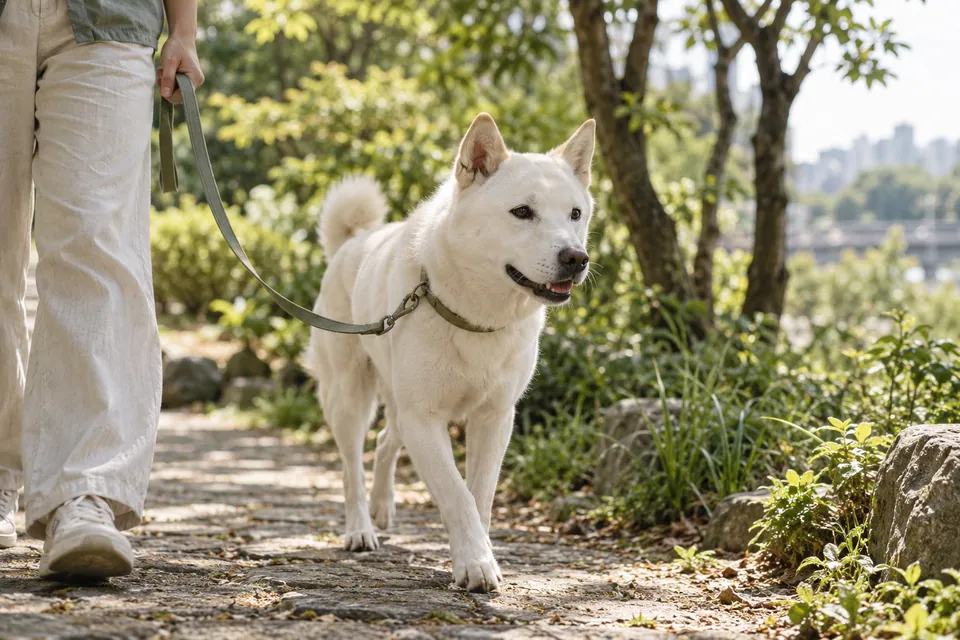
How do harnesses and collars differ?
The biggest difference is where the force lands when the leash is pulled. In this article, a collar means equipment worn around the neck, and a harness means equipment that wraps around the chest and torso. With a collar, when the leash is tugged the force is concentrated at a single point on the neck, while with a harness the force is spread over several points on the torso.
A guide for owners published by a US veterinary hospital chain (VCA Animal Hospitals) explains that pulling hard on a regular flat collar can put too much pressure on the delicate tissues of the neck and may cause damage. The same material advises that a body harness reduces pressure on delicate tissues and is therefore a good option for dogs with tracheal disease or neck pain. The RSPCA Australia knowledge base also states that a harness does not pull on the neck and is ideal for walking.
That does not mean a collar is unnecessary. A collar is the basic equipment that can hold an ID tag and a leash, and the VCA material explains that a flat collar should fit snugly without being tight and has a ring for hanging an ID tag. In other words, it is easier to choose if you think of two separate uses: everyday wear (attaching an ID tag) and taking force on a walk.
It cannot be said that one piece of equipment is better for every dog. The explanations above are general guidance from veterinary hospitals and animal welfare organizations, and results can differ depending on the dog's neck structure, coat length, pulling habits and body shape.
Comparing collar, harness, head collar and martingale types
The table below summarizes, in English, guidance from VCA Animal Hospitals and the RSPCA Australia knowledge base and compares it by type. It does not evaluate any specific product or brand, and it is not a ranking of which type is better.
As the table shows, each type has advantages along with points of caution. Even among harnesses, the ring position differs, as with front-clip and back-clip, so as the VCA material says, you need to choose a form that suits the dog's body shape, and trying it on and checking is important.
A head collar (head halter) consists of a strap behind the ears and a strap around the muzzle, and when the leash is pulled the area around the muzzle tightens. RSPCA Australia advises that a head collar should not be the first choice, that many dogs find it uncomfortable, and that the head can be injured if it is jerked suddenly. A martingale collar has a structure in which a small loop tightens slightly when the leash is pulled; the VCA material explains that when fitted correctly it should not choke the neck, but does not recommend it as a training tool, because it can tighten too much.
| Type | Where the force lands | Advantages mentioned in guidance | Cautions mentioned in guidance |
|---|---|---|---|
| Flat regular collar | Neck | Can hold an ID tag and a leash and is used for everyday wear | Pulling hard can put pressure on the delicate tissues of the neck, and a loose one can slip off |
| Safety buckle (breakaway) collar | Neck | Made to release quickly under pressure, used for example when a dog might get caught while playing | If the leash is attached only to the breakaway ring the dog can escape, so some products must be connected to both rings |
| Martingale (limited-tightening) collar | Neck (limited tightening) | Reduces the risk of slipping out | Long hair can tangle, a wrong fit can tighten too much, and it is not recommended as a training tool |
| Body harness (back clip) | Chest and torso | Reduces pressure on the neck and is mentioned as a good option for dogs with tracheal disease or neck pain | If it does not fit, the dog can back out of it, and it must be fitted so it does not rub behind the elbows |
| Front-clip harness | Chest and torso (steering from the front) | Mentioned as used to turn direction in dogs that pull strongly | Some designs pass over the shoulder joint, restricting movement and possibly pressing on delicate tissues |
| Head collar (head halter) | Muzzle and head | Mentioned as used to reduce pulling | Needs conditioning, some dogs never accept it, and jerking the leash is dangerous |
Why is pressure on the neck and trachea a problem?
The neck contains delicate structures, and veterinary hospital guidance explains that when a dog pulls hard with a leash attached to a collar, excessive pressure can be put on those structures. The VCA Animal Hospitals material states that a habit of pulling hard on a flat collar or a safety buckle collar can damage the delicate structures of the neck.
What needs to be distinguished here is the level of evidence. The guidance this article checked is general explanation from veterinary hospitals and animal welfare organizations, and it did not find figures showing by what percentage a harness reduces injury compared with a collar. So you cannot conclude that a collar is dangerous, or that it is safe; it is enough to understand that you choose with the fact in mind that the force is concentrated on the neck.
Conversely, harnesses can also cause problems. The VCA material cautions that some front-clip designs sit over the shoulder joint, restrict movement, and put pressure on delicate tissues, which can lead to damage. That is why it advises checking that a harness is adjustable in all dimensions, that the front legs can move freely, and that nothing rubs behind the elbows. If a dog already has a problem such as tracheal disease, coughing or neck pain, it is safer for the owner not to decide alone which equipment to use but to discuss it with a veterinarian.
What safety measures are needed when going out in Korea?
In Korea, the Animal Protection Act (동물보호법) and its Enforcement Rule (동물보호법 시행규칙) set the length and labeling of equipment when taking dogs out. A MAFRA press release (Stricter punishment for animal abuse, tighter safety management for companion animals) advises that a leash or chest leash for registered animals going out should be within 2 m. The material explains that, taking awareness-raising and settling-in into account, this length standard takes effect 1 year later. Afterward, an article MAFRA published in Policy Briefing on 2022-02-09 announced that from February 11 the length of the leash or chest leash must be kept within 2 m when going out, and explained that even if the whole leash is longer than 2 m, holding the middle of the leash so that the length actually connecting the dog and the person is within 2 m is regarded as complying with the safety measure rule.
The same press release advises that, as the pet registration (동물등록) method no longer includes an ID tag, an ID tag with the owner's contact details and so on must be attached to the companion animal when going out, and that violations carry a fine of up to KRW 500,000. It also explains that in the shared spaces inside buildings such as multi-unit houses, multi-household houses and multi-family housing, the animal must be held directly in the arms, or its movement restricted by holding the neck portion of the leash or the handle of the chest leash.
There is a point here that connects to choosing between a harness and a collar. The wording of the law is leash or chest leash, so even when you use a harness, the leash must be within 2 m. RSPCA Australia advises against retractable leashes and bungee leashes, saying control is reduced and the neck can take a jolt. Also, since an ID tag is information that lets people contact you if the dog leaves home, it is worth checking whether a collar with an ID tag is used together even when only a harness is put on.
Because legal provisions are amended, please check the current content directly in the text of the Enforcement Rule of the Animal Protection Act on the National Law Information Center (law.go.kr). Article numbers are not given.
How do overseas standards differ?
Guidance from overseas animal welfare organizations is often a recommendation rather than law, and it varies by country. The RSPCA Australia knowledge base advises choosing a collar or harness and checking whether 2 fingers fit comfortably, and for dogs that pull strongly it recommends a front-clip harness, advising that it be fitted with the help of a trainer. Korea's system differs in that it focuses on leash length, ID tags and behavior in shared spaces rather than on the type of equipment.
Positions on choke (check) collars and spiked (prong) collars are also worth checking. The RSPCA Australia knowledge base states that these two cause pain and fear and can injure the neck, so they should not be used, and the VCA Animal Hospitals material also advises avoiding prong collars, choke collars and shock collars. SPCA New Zealand regards shock collars as causing pain and distress and as potentially harmful to long-lasting welfare and behavior, and states that it argues for a ban on the manufacture, import, sale and use of these devices. It presents physical methods such as fencing and reward-based training as alternatives.
RSPCA Australia explains that for electric shock devices it is concerned about physical discomfort and pain, fear and anxiety, damage to the bond between people and animals, and the risk of bites due to aggression, and states that there is no evidence that punishment-based methods are more effective. Legal status differs by country, and RSPCA Australia explains that use is banned in some Australian states.
This article is not a guide to training methods, so it does not cover how to correct leash pulling. It only summarizes that at the stage of choosing equipment, overseas organizations with one voice say to rule out types that cause pain or shocks.
What should owners check before buying and before putting it on?
When choosing equipment, it helps to go through the checklist below one item at a time rather than relying on advertising claims. These items organize the general guidance from VCA Animal Hospitals and the RSPCA Australia knowledge base in a form that is easy for owners to check.
- For a collar, check whether 2 fingers fit comfortably. This is a check method introduced by RSPCA Australia, but the VCA material has no such specific finger check, so the standard differs by organization, and it is better to leave the final check to a veterinarian or trainer.
- Young puppies grow quickly, so RSPCA Australia advises checking the fit several times a week or more.
- For a harness, check that it is adjustable in all dimensions, that the front legs can move freely, and that nothing rubs behind the elbows.
- Let the dog get used to new equipment slowly in a quiet place (VCA guidance).
- Take the harness off when you cannot watch the dog. If a collar or harness gets caught on something the dog can be hurt, so the VCA material cautions to watch the dog while it is wearing one.
- Use a head collar only on a leash held by a person, not on a long line or an automatically extending leash, and because it can come off, the VCA material advises using it together with a harness or buckle collar.
- Check that the leash is within 2 m and that an ID tag with contact details is attached (MAFRA guidance).
- Choke chains, prong collars and electric shock devices are types that overseas animal welfare organizations and veterinary hospital guidance say to avoid, so exclude them from the candidates.
What are some common misconceptions?
First, there is a claim that a dog pulls harder when a harness is used. No evidence supporting this claim was found in the materials opened and read this time. On the contrary, RSPCA Australia advises that for dogs that keep pulling even with reward-based training, a front-clip harness is in most cases the most suitable management tool. Since this is an area where different stories circulate, it is better not to state either side as fact.
Second, there is the idea that once a harness is on, the leash length rule and ID tag do not matter. MAFRA guidance says the leash or chest leash should be within 2 m, so the same standard needs to be checked for a harness leash too, and attaching an ID tag with contact details when going out is also advised separately.
Third, there is the idea that a martingale or head collar can substitute for training. The VCA material says it does not recommend the martingale as a training tool, and RSPCA Australia advises that a head collar should not be the first choice.
Fourth, there is the idea that mild-stimulus equipment that leaves no marks on the body is fine. RSPCA Australia states that it opposes not only electric shock devices but also citronella (spray) and ultrasonic collars, prong collars, anti-bark muzzles, and choke collars. The overseas organizations' position is not to regard something as acceptable because the stimulus is mild.
Fifth, there is the idea that if the size fits, you can buy it once and keep using it. Puppies grow, and adult dogs can also change weight, so the fit needs to be rechecked at regular intervals.
Gathering in one place what this article could not confirm: the text of the provisions on the National Law Information Center could not be read directly, and so article numbers, the detailed fine amounts for violating the length standard, and whether the law applies to retractable leashes could not be confirmed. The laws governing electric shock equipment in Korea could not be confirmed either. Materials comparing the merits of harness forms, and systematic literature reviews comparing equipment risks for specific breeds or conditions, were also absent from the materials opened and read.
When should you consult a veterinarian?
Choosing equipment itself is something an owner can do, but if there are warning signs in the body, it is better to tell a veterinarian. This article does not diagnose or prescribe, and the following are situations in which animal hospital consultation is generally worth considering.
- Repeated coughing, gagging, a hoarse voice or changes in breathing sounds during a walk or after pulling on the leash
- The dog shows pain when the neck or shoulder is touched, or walks with the head tilted to one side
- Hair loss, red skin or sores where the collar or harness touches
- Limping on a front leg or a change in gait while using a front-clip harness
- A past diagnosis of tracheal disease or neck pain and not knowing which equipment to use
- Great fear, such as hiding, freezing or trembling badly, as soon as the equipment is put on
In particular, for a dog with a history of tracheal or neck disease, a body harness can be an option as in the VCA Animal Hospitals guidance, but the suitable type must be decided in an individual examination. For equipment fitting, the surest way is to put it on the dog in front of a veterinarian or a trainer who teaches with reward-based methods and have it checked. Difficulty breathing, lips or tongue turning blue, and collapse are, as general guidance, emergency signs to be taken as a reason to go to an animal hospital right away, before trying to change equipment.
Frequently asked questions
Q Is a harness better than a collar for small dogs?
It cannot be decided by size alone. The veterinary hospital and animal welfare organization materials checked this time had no separate criteria only for small dogs. Since there is guidance that a body harness is a good option for dogs with a weak neck or trachea, look at whether symptoms such as coughing are present and discuss with a veterinarian.
Q How many fingers should fit for it to be the right size?
The RSPCA Australia knowledge base introduces 2 fingers fitting comfortably under the collar as a check method. The VCA material says only that the collar should fit snugly without being tight and does not give a specific number of fingers, so take the dog's coat and body shape into account and have a veterinarian or trainer check it.
Q Is an ID tag still needed if the dog wears a harness?
A MAFRA press release advises that an ID tag with the owner's contact details and so on must be attached to the companion animal when going out, with a fine of up to KRW 500,000 for violations. This is separate from whether a harness is worn, so check the current Enforcement Rule on the National Law Information Center.
Q How long can the leash be?
MAFRA advises that the leash or chest leash for registered animals going out should be within 2 m. According to the Policy Briefing article, it applies from February 11, 2022. Check the fine amount directly on the National Law Information Center.
Q Is it all right to use a head collar or martingale?
The VCA material says a head collar needs conditioning and some dogs never accept it, and RSPCA Australia advises not making it the first choice. A martingale should not choke when fitted correctly but is not recommended as a training tool. Consult a veterinarian or trainer before using either.
Q Why are electric shock and prong collars advised against?
RSPCA Australia and SPCA New Zealand oppose them on grounds of pain, fear, and concerns about lasting anxiety and aggression. RSPCA states that there is no evidence punishment-based methods are more effective. Their legal status in Korea is not covered in this article.
Q Can I leave the harness on when the dog is at home?
The VCA material advises watching dogs wearing a collar or harness, and taking the harness off when you cannot watch directly, because the dog can get caught on something and be hurt. How to handle the ID tag while the dog is not going out should be decided to suit your individual situation.
Limits and scope of this guide
This article is a comparison of equipment types for general owners and does not judge the health of a specific dog or suitability by breed. Equipment suited to dogs with bronchial or tracheal disease, neck pain, short-muzzled breeds, or aggression or extreme fear should be discussed with a veterinarian. The materials opened and read are US veterinary hospital guidance and materials from Australian and New Zealand organizations, and what could not be confirmed (the text of the legal provisions, detailed fine amounts, the legal status in Korea of retractable leashes and electric shock equipment, and studies comparing injuries by equipment) is gathered at the end of the common misconceptions section of the body. The positions of overseas organizations are recommendations and not Korean law.
Translated from the Korean edition · Editorial draft, not professionally reviewed. The Korean edition is an explainer newly written from public sources; it is not a full translation of those sources. Veterinary expert review has not been completed. For decisions about your pet's health, talk to a veterinarian who knows your pet.
Sources and check dates
- Stricter punishment for animal abuse, tighter safety management for companion animals (동물학대 처벌 엄중하게, 반려동물 안전관리 촘촘하게) ↗
Basis for the leash/chest leash within 2 m, the ID tag when going out with a fine of up to KRW 500,000, and the shared-space safety measure guidance.
- Dog leash and chest leash within 2 m when going out: stronger owner obligations (외출시 반려견 목줄·가슴줄 2m 이내로…보호자 의무 강화) ↗
Basis for the effect from February 11, 2022, the 2 m leash length standard and its interpretation when the middle of the leash is held, and the shared-space safety measure guidance.
- Enforcement Rule of the Animal Protection Act (동물보호법 시행규칙) ↗
Given as the place to check the current provisions directly. When opened, the text of the provisions did not appear on screen, so the figures in this article rely on the MAFRA material and the Policy Briefing article.
- Collar and Harness Options for Dogs ↗
Basis for the features by type of collar, harness, head collar and martingale, neck and trachea pressure, fit checks, and guidance on equipment to avoid.
- What equipment should I use when teaching my dog or puppy to walk on a leash? ↗
Basis for the 2-finger check method, the position on front-clip harnesses and head collars, and the opposition to choke and prong collars.
- What are the animal welfare issues with electric shock collars on dogs? ↗
Basis for the opposition to electric shock devices and other aversive equipment and the welfare concerns.
- Electric shock collars ↗
Basis for the animal welfare organization's position on electric shock collars (concern about pain and distress, call for a ban, reward-based alternatives).
Korean edition checked · translated · each source may have a different check date. No paid partnerships.
This guide relies on 2 Korean laws or notices. Current effective dates and upcoming amendments are listed on Korean law check status. This is not legal advice.