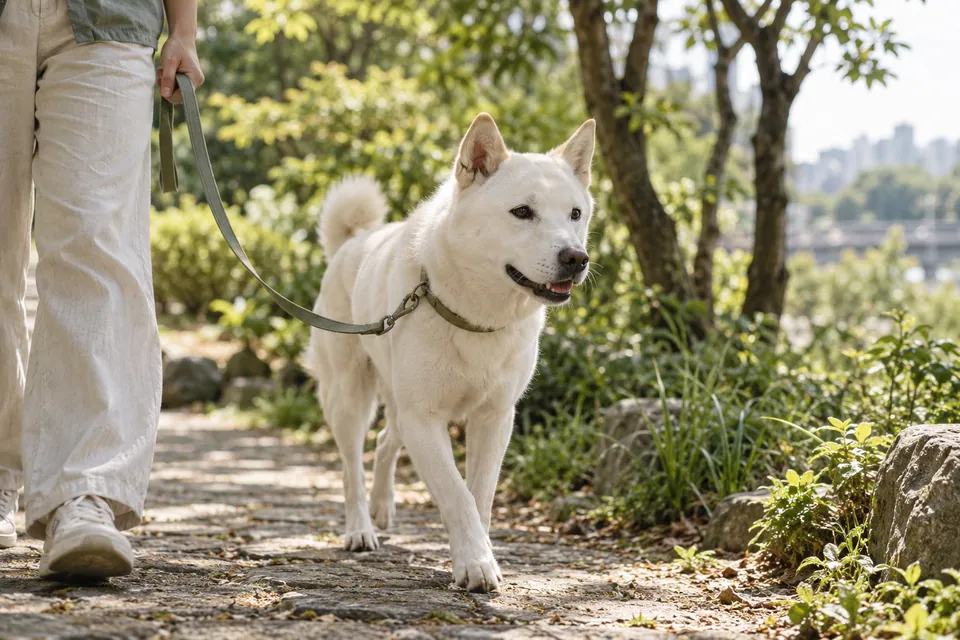
How many minutes of walking a day is the right answer?
In short, there is no walking time that suits every dog equally. The American Kennel Club (AKC) exercise guidance explains that the amount of exercise needed differs from dog to dog and depends on age, health and breed, and it advises talking to a veterinarian or breeder without giving specific numbers such as minutes or hours. The UK animal charity PDSA advises that, depending on the dog, some breeds need 1 to 2 hours or more of exercise a day and working breeds need much more than that, and it states that most dogs should be walked at least once or twice a day unless a vet advises otherwise.
So it is better to use numbers you see online, such as 30 minutes or 1 hour a day, only as a starting point. Even with the same owner, an active medium-sized dog, a small senior dog and a short-nosed breed all differ in both the amount they need and the limit they can tolerate. This article introduces only the ranges that the sources gave directly, and considers it appropriate to decide the exact amount for an individual dog together with a veterinarian.
The standard you can actually use is not a timetable but how the dog looks after the walk. If the dog rests comfortably afterward and its appetite and condition are the same as usual, the amount is generally about right; if its excitement does not settle for a long time, or conversely it is so tired that it moves sluggishly until the next day, that is a sign to review the amount or intensity. This distinction is this article's interpretation, and individual conditions need a veterinary consultation.
What is a walk for?
A walk is not only an outing for toileting. PDSA advises that brisk walks help burn energy, while slow walks that let the dog sniff and explore are good for mental health. It also explains that letting the dog sniff and look around during a walk is good for its mental wellbeing. In other words, a single walk contains a part that uses the body and a part that uses the mind.
The AKC advises that a walk is not just time for a dog to sniff the bushes and do its business, but can be an opportunity to train, share new experiences and build a bond. It adds that for senior dogs, experiencing new sights, sounds and smells helps keep them stimulated. Taken together, these explanations suggest the purposes of a walk can be roughly divided into three.
- Exercise: moving the body and using energy by walking and light running
- Sniffing and exploring: slowly stopping to take in the surroundings
- Social stimulation: time with the owner, and meeting the outside environment such as people and other dogs
Social stimulation is especially important during puppyhood, but because the list of experiences during the socialization period is covered in a separate article, this article only points out that, when meeting an unfamiliar dog on a walk, you should first check whether vaccinations are finished. When planning a single walk, it is worth first thinking about whether you can include all three of these. If you only pull the dog along the same route at a set pace, it gets exercise but fewer chances to explore. PDSA advises that play such as training, brain games and food puzzles can also be used to prevent boredom, so on days when the weather is bad or the dog is unwell and you need to shorten the walk, one option is to make up for it indoors with these activities.
How do walks differ for puppies, adult dogs and senior dogs?
A young puppy may look full of energy, but its body is still growing. The AKC advises that puppies are better off exercising in several short sessions, and that one long walk can strain a growing body. PDSA also explains that too much exercise or many high-impact activities can be a risk to joints and bones that are still developing, and that this may lead to arthritis or hip dysplasia. It also advises that excessive exercise often gives no clear warning signs before joint damage occurs, so owners need to watch activity and rest.
PDSA states that the commonly cited rule of 5 minutes per month of age has no scientific basis. So the approach of multiplying age in months by 5 to set walking time is hard to treat as evidence. The same document advises avoiding long walks, hiking, running and cycling alongside the owner until the dog is fully grown. Most dogs finish growing around 1 year old, but it says large breeds such as Greyhounds, Labradors, Dobermans and Great Danes can take 18 months to 2 years. For puppies that have not yet been vaccinated, PDSA advises starting walks in public places only after all vaccinations are finished, and before that, carrying the puppy and filling the time with play and training at home. Discuss the vaccination schedule with a veterinary clinic.
Adult dogs can stay in shape with daily exercise that suits their breed and personality. The AKC advises that highly active breeds need much more exercise, and that dogs with hip dysplasia or heart or respiratory disease need a routine within a comfortable range set together with a veterinarian. For a dog that has been getting too little exercise and is just starting, it is worth noting that the AKC advises 10 to 15 minutes of walking is a good starting point.
Senior dogs can have their pace and amount reduced. PDSA says senior dogs may need a little less exercise than before, and advises avoiding games such as ball throwing, which involve sudden starts and stops that strain the joints, for older dogs and dogs with arthritis. On the other hand, the AKC says exercise is just as important for senior dogs as for puppies, and advises replacing running with walking, and that slow, frequent movement helps dogs with arthritis. It also introduces the option of putting the dog in a cart or stroller to give it rests during a walk. The age and signs of aging that decide whether a dog counts as senior are covered in a separate article on senior dogs.
Why do short-nosed brachycephalic dogs need extra care?
The UK RSPCA calls the breathing problems that occur in short-muzzled brachycephalic dogs brachycephalic obstructive airway syndrome (BOAS), and advises owners to check breathing every day, especially during and after exercise and in hot weather.
Cornell University College of Veterinary Medicine explains that brachycephalic dogs such as Pugs, Bulldogs, Boston Terriers and Boxers pant less efficiently and so overheat more easily on hot or humid days. The UK RSPCA likewise says that strenuous activity and exercising in hot weather can make breathing problems worse, and advises that exercise is important but should be kept moderate so as not to overdo it, that walks should be avoided on hot days, and that if you must go out, you should choose early morning or late evening. It advises that using a harness instead of a collar avoids pressure on the neck.
The breathing signs owners should check during and after a walk are also given in the sources. The RSPCA lists the following as signs of BOAS: noisy breathing such as wheezing or snorting, increased effort to breathe, being unable or unwilling to exercise, holding the head high or sleeping sitting up, collapsing, and breathing with the mouth open when not exercising. It says to contact a veterinarian if BOAS is suspected, and the RSPCA advises regular check-ups even when there seem to be no problems. This article's recommendation is that if you see these signs during a walk, you let the dog rest and ask a veterinary clinic. However, not every brachycephalic dog shows the same degree of symptoms, so it is good to confirm your own dog's limit with a veterinarian.
How should you watch for heat, cold and asphalt?
For walks in hot seasons, the choice of time of day is the biggest variable. Cornell University College of Veterinary Medicine advises walking in the early morning or evening, and says the hottest time is around 3 to 5 p.m. It also explains that strenuous exercise should be avoided during the hottest hours, on very humid days, and in early summer before the dog has adapted to the heat. PDSA also advises exercising only at cool times in summer and bringing water on walks. Besides brachycephalic dogs, the dogs Cornell lists as being at higher risk are overweight dogs, older dogs, dogs with heart or respiratory disease, and dogs with thick or dark coats.
Cornell explains that asphalt can get much hotter than the air temperature and can burn paw pads. As a way to check, it introduces the 10-second test: if the ground is too hot to stand on barefoot for about 10 seconds, it is too hot for the dog as well. This method is Cornell's guidance, and if in doubt, it is safer to postpone the walk or choose grass or shaded paths.
As early signs of overheating, Cornell lists heavy panting, seeking shade, whining, not wanting to play, and drooling. It advises that excessive panting and drooling, difficulty breathing, vomiting, weakness, confusion, seizures and collapse are emergency signs that require going to a veterinary clinic immediately. Because how to handle heatstroke is covered in detail in a separate article, all you need to remember here is that if you see these signs during a walk, you stop and rest right away and contact a veterinary clinic.
On cold, PDSA advises considering how much your dog feels the cold in winter, and recommends a high-visibility vest and a visible leash or harness after dark. We did not find a source that gives a specific below-zero threshold this time, so the dog's response takes priority, for example heading back early if a dog is shivering or reluctant to walk.
What rules must you follow when walking a dog in Korea?
The basics of walking rules in Korea are in the Animal Protection Act (동물보호법) and its Enforcement Rule (시행규칙), and the Seoul Metropolitan Government and local district offices publish guidance on them. Based on the Seoul Media Hub's guide to walking dogs and the Geumcheon-gu Office's guide to the legal obligations of pet owners, the summary is as follows.
- When going out, you must use a leash or chest leash of 2 m or less in length, or use a carrier with a locking mechanism (Easy-to-Find Korean Law, Article 16 (Management of Animals Subject to Registration, etc.), paragraph 2 of the Animal Protection Act and Article 11 of the Enforcement Rule). The Geumcheon-gu Office advises that even with a longer leash, holding it short within 2 m is regarded as compliant. This 2 m is the upper limit for going out. When a dog is kept tied by a leash at home, there is a separate keeping and management standard (Annex 2 of the Enforcement Rule of the Animal Protection Act) that conversely requires the leash length to be at least 2 m, so the two numbers must not be confused.
- You must attach an ID tag with the dog's name, the owner's contact details and the pet registration number (동물등록번호). The Geumcheon-gu Office advises that wearing an ID tag must be complied with separately even if the dog has an implanted pet registration.
- When going out, carry waste bags and pick up waste immediately when it is produced. It advises that urine on shared spaces such as stairs or elevators, or on benches and chairs, must also be wiped up right away.
- In the shared spaces of buildings such as apartments (stairs, corridors, elevators and so on), you must hold the dog in your arms or hold the leash short to restrict its movement.
- The Geumcheon-gu Office advises that dogs under 3 months old can be carried.
The standards for dangerous dogs are stricter. According to Seoul guidance, when going out they must wear both a leash and a muzzle, using only a chest leash is not permitted, and the muzzle can be omitted for dogs under 3 months of age. The Geumcheon-gu Office advises that under the Animal Protection Act, dangerous dogs are the Tosa, American Pit Bull Terrier, American Staffordshire Terrier, Staffordshire Bull Terrier, Rottweiler and each of their crossbreeds. Owners of dangerous dogs have obligations such as taking out liability insurance and attending regular training, and entry is restricted at places such as daycare centers, kindergartens, elementary schools, special schools, children's parks and children's playgrounds.
Fines should be looked at by separating the maximum set by law from the amount actually imposed. Easy-to-Find Korean Law advises that failing to comply with safety measures such as the leash, the ID tag and waste pickup each carries a fine of up to KRW 500,000 (Article 101 (Fines), paragraph 4 of the Animal Protection Act), and failing to register an animal subject to registration carries a fine of up to KRW 1,000,000 (Article 101, paragraph 3, item 4 of the same Act). The Seoul environment website advises that the fine for non-registration is KRW 200,000 for a first violation, KRW 400,000 for a second and KRW 600,000 for a third, depending on the number of violations, and the Seoul Media Hub (2023) also gave the non-registration fine as up to KRW 600,000 and violations of dangerous dog owner obligations as up to KRW 3,000,000. That is, KRW 1,000,000 is the maximum under the law, and KRW 600,000 is the number given as the largest of the amounts actually imposed by number of violations. However, this article could not directly open and cross-check the original table of fine imposition standards in the Enforcement Decree of the Animal Protection Act, so it is better to confirm the exact amount imposed with the animal protection department of your local government.
What should owners check before and after a walk?
The habit of observing the dog is a more reliable standard than time. The table below organizes the guidance of the sources introduced in this article into before, during and after the walk, and it is not a table for diagnosing any specific illness.
If one of the items in the table has changed from usual, it does not immediately mean a serious illness. However, if the same change repeats or does not improve even when you shorten walks, noting it down and showing it to a veterinarian makes the consultation much easier. It is enough to briefly write down the date, walk length, weather and whether the dog rested.
| When | What to check | Basis or reason |
|---|---|---|
| Before the walk | Temperature and humidity, and whether it is a time of day that avoids midday | Cornell: early morning or evening, avoid strenuous exercise on humid days |
| Before the walk | Whether the ground is not hot (10-second test) | Cornell: too hot if you cannot stand barefoot for 10 seconds |
| Before the walk | Leash within 2 m, ID tag, waste bags, water | Seoul and Geumcheon-gu Office guidance, PDSA (bringing water) |
| During the walk | Panting, gait, sitting down, limping | AKC: watch senior dogs for limping, stopping and heavy panting |
| During the walk | Whether you are giving time to sniff | PDSA: slow sniffing walks are good for mental health |
| During the walk (brachycephalic) | Noisy breathing, open-mouth breathing, collapse | RSPCA: signs of BOAS |
| After the walk | Speed of recovery, appetite, movement the next day | Too much exercise can affect joints without warning (PDSA) |
What are common misconceptions about walking?
First, there is the idea that the longer the walk, the better. The AKC and PDSA advise that for a young puppy, one long walk can strain a growing body. For senior dogs and brachycephalic dogs too, it is safer to walk for short periods, often, and at cool times rather than to lengthen the walk.
Second, there is the formula that a puppy only needs to walk its age in months times 5 minutes. PDSA states that this rule has no scientific basis, so it is better not to apply this number mechanically. If the puppy sits down or seems overwhelmed, shorten the walk, and it is safer to discuss the individual condition with a veterinarian.
Third, there is the idea that stopping to sniff is a waste of time. PDSA advises that slow walks that let the dog sniff and explore are good for mental health. A good walk is not only one that gets quickly to the destination.
Fourth, there is the idea that walks are unnecessary if the dog runs around in the yard or the house. We did not find research dealing with this topic alone this time, but PDSA and the AKC advise that most dogs need regular walks, and they treat indoor brain activities as a complement to exercise rather than a replacement. The AKC also explains that mental stimulation complements physical exercise but does not replace it.
Fifth, there is the idea that an ID tag is unnecessary because a microchip has been implanted. The Geumcheon-gu Office guidance states that wearing an ID tag must be complied with separately even if the dog has an implanted registration.
When to consult a veterinary clinic
Many walking problems can be managed through the owner's observation, but in the cases below a veterinarian's check is needed rather than adjusting the amount of exercise. The AKC advises watching senior dogs for signs of pain or fatigue such as limping, stopping and heavy panting, and PDSA advises asking a veterinarian when the dog seems to struggle on walks, when you are worried about weight and fitness, or when you do not know how much exercise is right.
- When the dog limps on one leg or has trouble getting up after a walk
- When the dog gets out of breath faster than usual and often sits down or does not want to go during a walk
- When you see noisy breathing, open-mouth breathing or collapse (especially careful with brachycephalic dogs)
- Signs of overheating such as heavy panting with drooling, vomiting, weakness, confusion or seizures (advised as an emergency)
- When you do not know how far a sick or injured dog may walk (PDSA advises following the vet's rest instructions)
For signs close to an emergency, it is better to contact the clinic first and be told how to transport the dog. PDSA also advises that building fitness gradually and letting the dog adapt slowly to a new exercise routine is needed to avoid injury.
For problems such as trouble when meeting other dogs on a walk or heavy pulling on the leash, reward-based training is recommended over physical punishment. If it persists, consult a veterinarian or a veterinary behavior specialist.
Frequently asked questions
Q How many times a day and for how many minutes should I walk my dog?
There is no number that suits every dog. PDSA advises that most dogs need walks at least once or twice a day, and the AKC says the amount needed varies with age, health and breed and advises talking to a veterinarian. Gauge it by whether the dog rests comfortably after the walk.
Q Is it all right to skip a day of walking?
There is no source we opened that deals directly with this question. However, PDSA and the AKC advise that regular exercise is needed. When you have to cut back because of the weather or illness, you can make up for it with indoor activities such as the brain games and food puzzles PDSA introduces.
Q Can a puppy that has not finished its vaccinations go for walks?
PDSA advises starting walks in public places only after all vaccinations are finished, and before that, carrying the puppy and filling the time with play at home. Discuss the vaccination schedule and when to start with a veterinary clinic.
Q How can I tell whether asphalt is hot?
Cornell University College of Veterinary Medicine advises that if the ground is too hot to stand on barefoot for about 10 seconds, it is likely too hot for the dog as well. It is safer to walk in the early morning or evening and, if in doubt, to choose grass or shaded paths.
Q Can I use a retractable leash longer than 2 m?
Easy-to-Find Korean Law advises using a leash or chest leash of 2 m or less in length when going out, and the Geumcheon-gu Office explains that even with a longer leash, holding it short within 2 m is regarded as compliant. However, in the shared spaces of buildings you must carry the dog or hold the leash short. Check the detailed standards with your local government.
Q Should brachycephalic dogs not be walked at all?
No. The RSPCA advises that exercise is important but strenuous activity and hot weather can worsen breathing problems. Use a harness and walk briefly at cool times, and if breathing seems abnormal, rest right away and contact a veterinarian.
Q My dog keeps stopping to sniff on walks. Should I pull it along?
PDSA advises that slow walks that let the dog sniff and explore are good for mental health. Try mixing brisk stretches with sniffing stretches, and consider giving the dog time to stop in a safe place rather than pulling hard on the leash.
Limits and scope of this guide
This article is general guidance for owners and does not replace a diagnosis or prescription for a specific dog. Because the sources do not give a single number for daily walking time, no range was set, and the below-zero temperature threshold and detailed exercise amounts by breed could not be confirmed. The rules in Korea are based on Seoul and Geumcheon-gu Office guidance, and the text of the Ministry of Government Legislation could not be opened and checked, so the latest amendments and fines must be confirmed with the local government. For the criteria for senior dogs, how to handle heatstroke, and socialization, see the separate articles.
Translated from the Korean edition · Editorial draft, not professionally reviewed. The Korean edition is an explainer newly written from public sources; it is not a full translation of those sources. Veterinary expert review has not been completed. For decisions about your pet's health, talk to a veterinarian who knows your pet.
Sources and check dates
- Enjoy walks with your dog the wise way! Please follow these rules (반려견과 슬기로운 산책생활! 이건 꼭 지키개~) ↗
Used as the basis for the leash within 2 m, ID tag, waste pickup, movement in shared spaces, and the dangerous dog muzzle and fine guidance.
- Legal obligations of pet owners (반려동물 소유자의 법적 의무사항) ↗
Used as the basis for the interpretation of leash length, the relationship between the ID tag and implanted registration, waste bags, carrying dogs under 3 months old, and the scope of dangerous dogs.
- Take these along when going out with your dog (Living with Pets) (반려견과 외출 시 이것만은 챙기세요(반려동물과 생활하기)) ↗
Used as the basis for the leash or chest leash of 2 m or less when going out (Article 16, paragraph 2 of the Animal Protection Act), the ID tag and waste pickup obligations, and the fine of up to KRW 500,000 for each (Article 101, paragraph 4).
- Dogs are animals subject to registration (Living with Pets) (반려견은 등록대상 동물입니다(반려동물과 생활하기)) ↗
Used as the basis for the fine of up to KRW 1,000,000 for not registering an animal subject to registration (Article 101, paragraph 3, item 4 of the Animal Protection Act).
- Caring for dogs and cats (Living with Pets) (반려견·반려묘 돌보기(반려동물과 생활하기)) ↗
Used as the basis for the leash length of 2 m or more when keeping a dog tied up (Annex 2 of the Enforcement Rule of the Animal Protection Act).
- Guide to pet management (pet registration and obligations) (반려동물 관리 안내(동물등록·준수사항)) ↗
Used as the basis for the non-registration fine guidance of KRW 200,000 for a first violation, KRW 400,000 for a second and KRW 600,000 for a third.
- Summer Heat Safety Tips for Dogs ↗
Used as the basis for hot times of day, the asphalt 10-second test, brachycephalic risk, and signs of overheating.
- How Much Exercise Does a Dog Need? ↗
Used as the basis for the point that the amount of exercise varies with age, health and breed, and for the exercise guidance for puppies and senior dogs.
- How Often Should You Walk Your Dog? ↗
Used as the basis for starting with 10 to 15 minutes for dogs with little exercise, and for checking the walking pace and pain signs of senior dogs.
- How much exercise does your dog need? ↗
Used as the basis for walking at least once or twice a day, sniffing and mental stimulation, weather, and when to consult a veterinarian.
- Exercising your puppy ↗
Used as the basis for walking after vaccination, the joint risk of too much exercise, and the point that the 5-minute rule has no basis.
- Caring for dogs with brachycephaly ↗
Used as the basis for harness use in brachycephalic dogs, limiting walks on hot days, and signs of abnormal breathing.
- Table of contents of the Animal Protection Act (Article 15 Registration of Animals Subject to Registration, etc. · Article 16 Management of Animals Subject to Registration, etc. · Article 101 Fines) (동물보호법 조문 목차(제15조 등록대상동물의 등록 등 · 제16조 등록대상동물의 관리 등 · 제101조 과태료)) ↗
Used as the basis for cross-checking the article numbers and article titles of the Animal Protection Act used in the body (Article 16 Management of Animals Subject to Registration, etc., Article 101 Fines).
Korean edition checked · translated · each source may have a different check date. No paid partnerships.
This guide relies on 3 Korean laws or notices. Current effective dates and upcoming amendments are listed on Korean law check status. This is not legal advice.