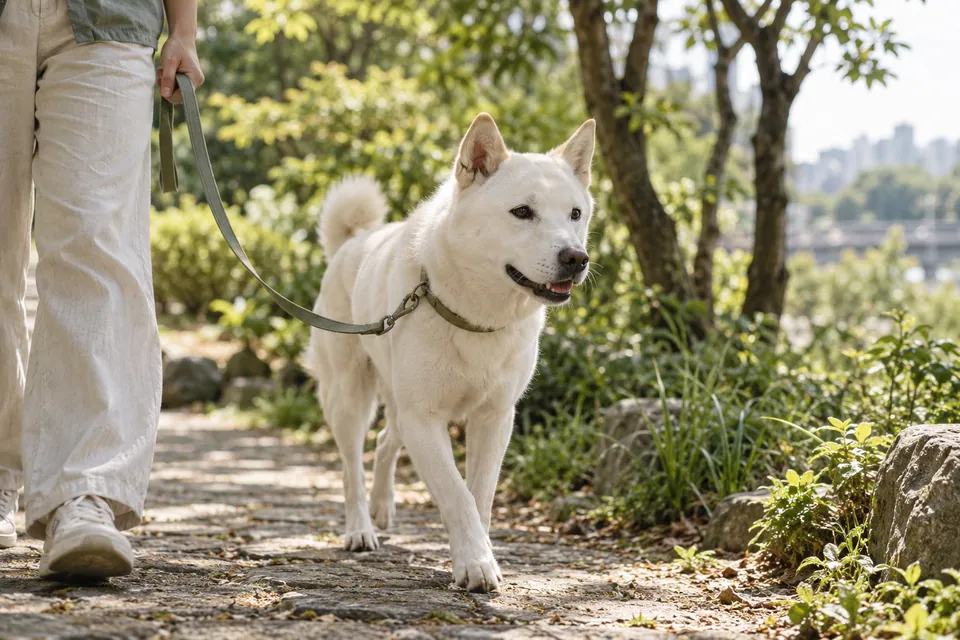
The short answer: do dogs really need boots and paw protectors?
To put the conclusion first, boots or paw protectors are not a must for every dog. A post on the Consumer24 safety information site by the pet team of the National Institute of Animal Science explains that a dog's paw pads are sturdy, made of a thick fat layer and keratinized epithelial cells, so dogs usually walk barefoot. The same post, however, says that stepping on calcium chloride spread on roads on snowy days can injure the paws, and that in dry winter weather injuries happen more easily. In other words, bare paws are enough in ordinary times, but protection may be needed in certain situations.
Those situations are mainly 2. One is having to walk on a route sprayed with de-icing salt in winter, and the other is having to walk on asphalt or sand baked by the sun in midsummer. In both cases, the first thing to do is not to buy a product but to change the route and the time of day. Going around to a route without de-icing salt, or moving the walk to morning or evening in summer, comes before products.
If it is still hard to change the route, types such as boots, disposable rubber balloon-style covers, sock-style covers, and paw wax or balm can be considered. This article does not say which product is good. It sets out what each type protects against, what is inconvenient about it, how to choose, and how to get a dog used to it, based on guidance from public agencies and overseas animal organizations. Walk distance and frequency are covered in other articles, so this article focuses on paw protection.
The 3 questions readers ask most often, namely whether it is all right to walk on a calcium chloride route, why a dog walks oddly in boots, and whether paw wax works, are answered in turn in the sections below and in the FAQ. First, the differences between types are shown in a table, and then the evidence is reviewed.
How do the types of paw protection products differ?
Paw protection products can be divided into 4 main types. The table below sets out what each type does and what to check. The content of the table is based on general explanations in agency guidance (ASPCA, Cornell University College of Veterinary Medicine) and on usage characteristics that owners commonly experience.
The ASPCA says boots cover the paws more widely than bare paws and can keep sand and salt from lodging between the toes and causing irritation. The same organization introduces rubbing a product such as petroleum jelly onto the paw pads before a walk to protect against salt and chemicals. Cornell University College of Veterinary Medicine health information also writes that balm or petroleum jelly may help prevent and soothe cracked paw pads. However, this wording only expresses a possibility, and I could not find a source that confirms the size of the effect in numbers.
There are points to keep in mind when reading the table. If a protector is applied, the dog may lick that area, and the owner cannot know how much was licked. Boots that do not fit can rub or come off, and disposable balloon-style covers are discarded after one use and can tear easily when the ground is wet. Whichever type is used, it does not replace checking the paws directly after a walk.
| Type | What it protects against | What is inconvenient or worth checking | When it fits |
|---|---|---|---|
| Boots with soles | De-icing salt, ice and sand touching the paw pads and the spaces between the toes; contact with hot ground | Rubbing or coming off if the size is wrong, an awkward gait before the dog is used to them, ankle pressure when worn for a long time | When a de-icing salt route is hard to avoid, or on very rough ground |
| Disposable rubber balloon-style | Contact with water, soil and de-icing salt | Single-use design, tearing and waste | Temporary use for short outings or rainy days |
| Sock-style | Eases friction, prevents light dirt | Slippery without soles, and when wet can stay on the paws holding de-icing salt | For temporarily covering the paws of a dog that slips indoors or keeps licking its paws |
| Paw wax or balm | Eases contact with salt and chemicals; possibly eases dryness and cracking | Can be licked and swallowed, can get on the floor after application or make it slippery | A backup for a dog that refuses boots altogether |
Why can winter de-icing salt be a problem for paws?
De-icing salt is a salt spread to melt ice. The ASPCA lists sodium chloride (rock salt), calcium chloride, potassium chloride and magnesium chloride as de-icer ingredients. This organization says that swallowing rock salt, the most common, can raise sodium levels dangerously high, and that the other chloride-based products irritate the digestive tract more and can cause bloody vomiting or diarrhea and electrolyte changes. It also says that rock salt can irritate the paws, so limping or excessive paw licking can be signs of discomfort.
The key point here is to think about contact and licking separately. Contact alone can irritate dry or cracked paw pads, and if a dog licks its paws after a walk, the de-icing salt on the paws goes into its mouth. The Consumer24 post by the pet team of the National Institute of Animal Science also explains that clumped snow and moisture between the pads and toes must be wiped off so that calcium chloride or antifreeze does not come off with a lick. Cornell University College of Veterinary Medicine health information writes that swallowing salt from the road can cause ulcers or irritation in the mouth and digestive tract.
The ASPCA also points out that there is no special requirement for labeling a de-icing product as safe. So even if the packaging carries a safe-sounding phrase, it advises the same caution with all chemical de-icers. This is an explanation of overseas conditions, so it cannot be taken as identical to labeling in Korea. Within the range checked for this article, there was no public agency source giving in numbers how much de-icing salt must touch the paws to cause injury. So the honest way to understand it is as taking more care the longer the exposure and the drier or already cracked the paws are.
The level of this evidence is the general guidance of public agencies, animal organizations and university veterinary schools. In writing this article I could not find a source that confirmed the effect of boots or wax through a randomized controlled study or a systematic review.
What should I do about hot ground in summer?
In summer the problem is not de-icing salt but ground temperature. The ASPCA says that in very hot weather dogs should not be kept on hot asphalt for long, and that dogs close to the ground heat up quickly and sensitive paw pads can be burned, so walks should be kept to a minimum then. RSPCA South Australia in Australia says to hold the owner's bare hand or bare foot on sunlit ground for 10 seconds, and if that is uncomfortable, to treat it as too hot for the dog's paws too. This 10 seconds is one organization's benchmark, so it is enough to remember the principle of stopping if the hand is uncomfortable, rather than the number.
The Australian RSPCA post explains that burned paw pads hurt and make walking difficult, can lead to secondary infection, and that a dog may react aggressively when its paws are touched. The same post says to walk in the cool early morning or late evening, and to make walks shorter than usual if the temperature stays high at night. There is also guidance to choose a route with tree shade when the ground is too hot. In other words, in agency guidance the first priority for summer paw protection is the choice of time and route.
If boots are used in summer, how much the sole blocks heat from the ground may differ by product. Heatstroke itself is covered in other articles, but I only note that if a dog pants heavily or staggers on a hot day, it should be moved to a cool place immediately and receive emergency veterinary care. Protecting only the paws does not solve heat for the whole body.
How should de-icing salt and labeling be viewed in Korea?
In Korea, spraying calcium chloride-type de-icing salt on roads and apartment-complex walking paths when it snows is common. In writing this article I could not find de-icing standards or labeling rules issued by the Ministry of Environment, local governments or the Korea Consumer Agency for the purpose of protecting pets' paws. The Korean public guidance I checked directly is the January 2021 post by the pet team of the National Institute of Animal Science on the Consumer24 safety information site. This post advises checking for routes sprayed with calcium chloride and antifreeze on winter walks, suggests putting boots on dogs on snowy days, and says to wipe the snow and calcium chloride from between the pads and toes after returning home and wash the paws with lukewarm water.
Another post by the same team recommends not keeping boots on for 30 minutes or longer because they squeeze the ankles, and, if needed, massaging the paws after 30 minutes and then putting the boots back on. It also explains that a dog's paw pads are sturdy but vulnerable to injury from calcium chloride or dry weather, and introduces washing with lukewarm water after returning home and applying a moisturizing balm. This guidance is useful as a reference because it gives a specific time benchmark, but it is a single piece of guidance and may differ from dog to dog.
As a public scheme on the de-icer side, there is the Korean Eco-label (환경표지) explained by the Korea Environmental Industry and Technology Institute. The Eco-label is a nationally recognized scheme that certifies products that, among products of the same use, reduce energy and resource consumption and minimize pollutant generation at each stage of the product's life cycle, and the institute says it is based on Article 17 of the Act on Support for Environmental Technology and Environment Industry (환경기술 및 환경산업 지원법). However, this page only explains the Eco-label scheme in general and does not say whether an Eco-labeled de-icer is safe for pets' paws. An eco-friendly claim and a claim that something is safe for pets do not mean the same thing, so it is better to check the ingredients yourself and still keep the habit of wiping the paws. How the walking paths of an apartment complex are de-iced is decided by the management office and the local government, so asking the relevant body is an option if needed.
How does this differ from overseas standards?
Overseas animal organization guidance offers more options than Korean public guidance. The ASPCA presents boots and protectors such as petroleum jelly together as paw protection methods, and for households that use de-icers it advises choosing pet-friendly products, avoiding overuse, and keeping pets indoors while de-icing is under way. It also introduces non-chemical methods such as sand for traction, clay cat litter for absorbing moisture, and heated mats or stairs. Cornell University College of Veterinary Medicine says to train dogs to wear well-fitting boots.
A feature of the Korean Consumer24 post is that it recommends boots while giving the limit on wearing time concretely. By contrast, I could not find an upper limit on boot wearing time in the overseas sources opened for this article. Also, the overseas sources explain the ingredients separately, as rock salt, calcium chloride, potassium chloride and magnesium chloride, whereas Korean guidance is written around calcium chloride and antifreeze.
Climate and environment also differ. The Australian RSPCA centers on hot ground and says that above 25°C, at-risk dogs such as short-nosed breeds should avoid walks. The numbers in agency guidance assume the local climate, so it cannot be assumed that Korea's humid summers and downtown asphalt conditions are the same. A realistic approach is to take the principles from overseas guidance and calibrate the numbers with the owner's sense of touch with the hand and the dog's reaction.
What should owners check before and after a walk?
Checks before and after a walk are basic care with a clearer effect than products. The list below sets out the guidance of the ASPCA, Cornell University College of Veterinary Medicine, RSPCA South Australia in Australia, and the Consumer24 post in an order that is easy for owners to carry out.
- Before going out: Touch the ground with the back or palm of your hand, and if it is uncomfortable, change the time of day or the route. In winter, check whether the route has been sprayed with de-icing salt.
- When using products: Check whether the boots fit and are not rubbing or loose enough to twist. When applying a paw protector, watch so the dog cannot lick it right away.
- During the walk: If the dog suddenly lifts a paw, limps or stops walking, rest immediately and examine the paws. The ASPCA advises carrying a towel on long walks to wipe irritated paws.
- After returning: Wipe or wash the paw pads, the spaces between the toes, the legs and the belly with lukewarm water and dry them well. Remove snowballs lodged between the toes.
- Check: Look for cracking of the paw pads, redness between the toes, and ice or sand caught in the fur.
When boots are used, the adjustment stage also matters. First put them on briefly indoors, build a good experience with treats, and then gradually lengthen the time. At first it is common for a dog to lift its paws high or walk awkwardly, which appears to be a reaction to a change in the feeling at the toe tips. As in the Consumer24 post, boots squeeze the ankles, so do not keep them on for long, and choose the size by measuring the length and width of the paw pad. Each time you take them off, check whether the nails are pressed against the inside of the boot or the heels are rubbed. This adjustment order is the agencies' general principles (well-fitting boots, training) loosened up so owners can follow them more easily.
What are the common misunderstandings?
The first misunderstanding is the idea that boots make the paws completely safe. Boots reduce contact, but de-icing salt can get on the paws or fur when they are taken off, and salt that has gotten inside the boot may stay in contact with the paws. So even when boots are worn, the paws should be wiped or washed after the walk. This is in the same vein as the ASPCA and Cornell University College of Veterinary Medicine advising wiping after a walk separately from boots.
The second misunderstanding is that a product labeled eco-friendly or pet-safe is fine if licked. The ASPCA says there is no special requirement for safety labeling, and for the Eco-label scheme, which certifies a product's environmental performance over its whole life cycle, I could not confirm any explanation that it assures safety when swallowed by an animal. So even with a label, keep the habit of not letting the dog lick and of wiping the paws.
The third misunderstanding is that applying paw wax means boots are not needed. Wax or balm can be an option for a dog that refuses boots altogether. There is also the point that the dog may lick it after application. The fourth misunderstanding is the idea that paw licking is a habit and can be left alone, but the Australian RSPCA advises going to an animal hospital if a dog keeps licking paws that have become red, or limps. Finally, an odd gait in boots can usually be part of the adjustment process. But if the odd gait does not improve after several days, or the dog keeps holding up only one paw, suspect the boot size or the condition of the paw.
What this article could not confirm is as follows.
- Studies that directly compare the effect of boot types and wax types
- How much a boot sole blocks heat from hot ground
- A ranking of risk by de-icer ingredient
- The reason for an awkward gait in boots and a specific adjustment period
- The exact duration of wax or balm
When should I go to an animal hospital?
The stage that can be handled with products and the stage that needs veterinary care are different. If the paw pads are cracked or bleeding, if the dog limps, if it keeps licking or biting its paws, or if the spaces between the toes are red and swollen, go to an animal hospital before changing protectors or boots. The Australian RSPCA advises going to a veterinarian if a dog keeps licking paws that have turned red or limps, the ASPCA says to check for cracked paw pads and redness between the toes after a walk, and Cornell University College of Veterinary Medicine says the pads can crack or be cut by ice and salt on the road, so check them often.
If there is a chance the dog licked de-icing salt, watching for symptoms is important. The Consumer24 post says licking calcium chloride or antifreeze can cause gastrointestinal illness, so watch whether the dog is lethargic or vomiting, and if these symptoms appear, take it to an animal hospital right away. The ASPCA says that if you suspect a toxic substance was swallowed, contact a veterinarian or an animal poison control center immediately. The ASPCA and Cornell University College of Veterinary Medicine also say that ethylene glycol in antifreeze is dangerous, and that if it may have been swallowed, seek veterinary care immediately. I could not confirm a poison consultation line available in Korea for this article.
When going to the hospital, it helps to tell them when and where you walked, what de-icer or antifreeze was present, what was applied to the paws, and how long the boots were worn. This article does not replace diagnosis or treatment, and it does not instruct you to apply medicine or ointment. The scope of public guidance is that mild dryness can be watched while wiping and moisturizing, and anything beyond that is for a veterinarian to judge. Dog clothes in general are covered in a separate article, so this article looked only at paw protection products.
Frequently asked questions
Q Is it all right to walk on a route sprayed with calcium chloride?
It is better to avoid it if possible. The Consumer24 post by the pet team of the National Institute of Animal Science says that stepping on calcium chloride can injure the paws. If it is hard to avoid, use boots or a protector, wipe and wash the paws after the walk, and keep the dog from licking them. If the exposure time is short and the paws are healthy, the effect may be small, but I could not find a source confirming this in numbers.
Q Why does my dog walk oddly in boots?
The feeling in the paw pads changes and the gait becomes awkward, which seems to be part of the adjustment process in most cases. Put the boots on briefly indoors and lengthen the time gradually, and check that they are neither tight nor loose. If after several days the dog keeps holding up one paw or refuses, check the size again and do not force them on.
Q Does paw wax work?
The ASPCA introduces rubbing petroleum jelly or similar onto the paw pads before a walk as a barrier against salt and chemicals, and Cornell University College of Veterinary Medicine writes that balm or petroleum jelly may help prevent and soothe cracking. However, I could not confirm any study measuring the size or duration of the effect. Also take into account that the dog may lick it after application.
Q How long can boots be worn?
The post on the Consumer24 safety information site says that boots squeeze the ankles, so it is better not to keep them on for 30 minutes or longer. It says that if needed, massage the paws after 30 minutes and then put them back on. I could not find a time limit in overseas agency sources, so keep in mind that this number is guidance from one Korean source.
Q How can I tell whether a summer road is hot?
RSPCA South Australia in Australia says to hold your bare hand or bare foot on sunlit ground for 10 seconds, and if it is uncomfortable, it is also too hot for the dog. The ASPCA says not to keep dogs on hot asphalt for long when the temperature is very high. Use whether the hand is uncomfortable as the benchmark rather than the number of seconds, and choose cool times of day and shaded routes first.
Q Do I have to wash my dog's paws after every walk?
In winter, wiping or washing is the basic care common to agency guidance. The ASPCA says to wash and dry the paws and belly after a walk, and Cornell University College of Veterinary Medicine says to remove salt and de-icers. The Korean Consumer24 post says to wash with lukewarm water. The aim is to keep de-icing salt from getting into the mouth when the dog licks.
Q My dog keeps licking its paws. Do I need to go to the hospital?
If the paws are red, or there is limping, cracking or bleeding along with the licking, it is better to go to the hospital. The Australian RSPCA advises going to a veterinarian if a dog excessively licks red paws or limps. If the dog is lethargic or vomits after licking de-icing salt, get veterinary care right away. Diagnosing the cause is the veterinarian's job.
Limits and scope of this guide
This article sets out criteria for choosing products for healthy adult dogs in general, and may not suit dogs with paw pad disease or sensitive skin, or senior dogs with joint or walking problems. What it could not confirm, such as the effect of boots and wax, the degree of heat blocking, and a ranking of risk by ingredient, is gathered under "What this article could not confirm" in the main text, and damage figures by amount of de-icer exposure could not be confirmed either, nor could de-icer standards or labeling rules for pets from the Ministry of Environment or local governments in Korea. Korean public guidance is a 2021 post on Consumer24. The overseas sources are general guidance from US, UK and Australian organizations, so they may differ from conditions in Korea. Diagnosis and treatment are left to a veterinarian.
Translated from the Korean edition · Editorial draft, not professionally reviewed. The Korean edition is an explainer newly written from public sources; it is not a full translation of those sources. Veterinary expert review has not been completed. For decisions about your pet's health, talk to a veterinarian who knows your pet.
Sources and check dates
- Tips for Safely Using De-Icers Around Your Canine ↗
Used as the basis for the risks by de-icer ingredient, signs of paw irritation, the absence of a safety labeling requirement, and wiping and rinsing after a walk.
- Cold Weather Safety Tips ↗
Used as the basis for the guidance on boots and petroleum jelly protectors, wiping the paws after a walk, and managing fur between the toes.
- Hot Weather Safety Tips ↗
Used as the basis for the guidance not to keep dogs on hot asphalt for long in very hot weather and that paw pads can be burned.
- Winter Safety Tips ↗
Used as the basis for the guidance on cracked paw pads, balm and petroleum jelly, boot training, and the antifreeze risk.
- Paws on the pavement – Walking your dog during summer ↗
Used as the basis for the 10-second hand-on-ground benchmark in summer, the effects of burned paw pads, time of day and shaded routes, and the guidance on going to the hospital.
- Let's get away from indoor and outdoor winter pet illnesses! (Safety information, 2021-01-11) (실내·외로 존재하는 겨울철 반려동물 질병으로부터 벗어나자!(안전정보, 2021-01-11)) ↗
Used as the basis for the caution about routes with calcium chloride and antifreeze, boots, wiping and washing after returning home, and the guidance to go to the hospital if symptoms appear after licking.
- Isn't a dog's standard for feeling cold different from ours? (Safety information, 2021-01-11) (반려견이 느끼는 추위의 기준이 우리와는 다르지 않을까?(안전정보, 2021-01-11)) ↗
Used as the basis for the structure of a dog's paw pads, avoiding boots for 30 minutes or longer, and injuries from calcium chloride and dry weather.
- Environmental certification scheme (Eco-label) (환경인증제도(환경표지)) ↗
Used as the basis for explaining the definition of the Eco-label, the operating body and the legal basis.
Korean edition checked · translated · each source may have a different check date. No paid partnerships.